

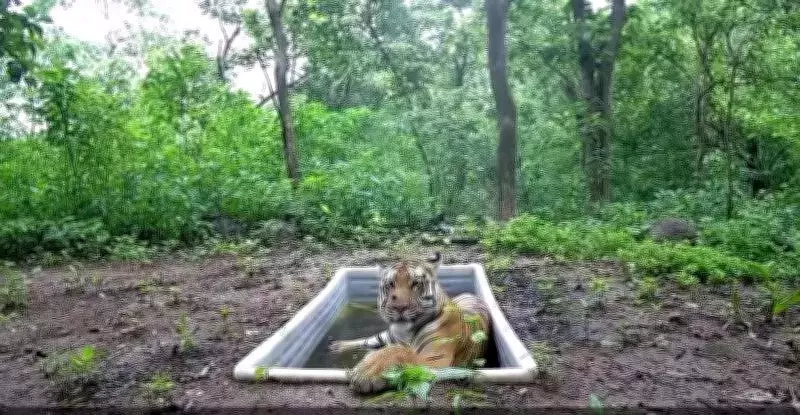
Gujarat's Lone Tiger: A Strictly Wild Hunter in Human-Dominated Landscape
A solitary tiger that has established a 120 square kilometer territory in eastern Gujarat is demonstrating remarkable adaptation by sticking exclusively to wild prey and deliberately avoiding human settlements. Forest officials have conducted detailed scat analysis, revealing that the big cat's diet is dominated by barking deer, with additional traces of nilgai and wild boar. This offers rare and valuable insights into how the animal manages to survive in a landscape heavily influenced by human activity without resorting to livestock predation.
No Evidence of Livestock in Tiger's Diet
Sources within the forest department have confirmed that samples collected so far show absolutely no evidence of cattle or domestic animals in the tiger's scat. A senior officer emphasized this point, stating, "The research team from Vadodara found no sign of livestock kill. All indicators point to wild prey." This underlines the tiger's deliberate avoidance of villages and grazing zones, showcasing its preference for natural forest habitats.
Structured Scientific Monitoring Programme
Beyond its hunting patterns, the tiger itself has become the subject of an intensive scientific study. The forest department has launched a structured monitoring programme to meticulously track its movement, feeding patterns, and behavior across the Ratanmahal landscape, where it has roamed for the past eleven months. Field teams are actively engaged in multiple activities:

- Analyzing scat samples to determine dietary habits
- Documenting scratch marks, pugmarks, and scent sprays
- Mapping the tiger's movement using geographical location data
This comprehensive approach aims to build a complete ecological profile of the animal.
Understanding Diet and Territory Use
Sandeep Kumar, Chief Conservator of Forest for the Vadodara Circle, explained the dual objectives of the study. "Scat analysis will help identify prey species, while field signs will allow us to map movement patterns and territorial behavior. So far, the tiger stayed away from human habitation and did not enter any village," he said. This research is crucial for developing effective conservation strategies that balance wildlife needs with human presence.
Unexpected Biodiversity Discoveries
The monitoring exercise has already yielded surprising and significant insights into regional conservation. Camera traps and video surveillance initially set up for the tiger have recorded several rare species, including rattlesnakes, flying squirrels, and pangolins, which were previously poorly documented in this area. The pangolin sightings are particularly noteworthy, as they challenge the long-held assumption that this species in Gujarat is largely confined to the Gir landscape.
Reshaping Ecological Perspectives
Senior officials have noted that these findings are fundamentally reshaping how the Ratanmahal region is viewed ecologically. A senior forest officer from Gandhinagar remarked, "This is no longer just about one tiger. The data reveals the wider biodiversity value of this entire forest belt." Consequently, a broader conservation proposal for the area is now under serious consideration, potentially leading to enhanced protection measures.
Ongoing Silent Hunts and Close Monitoring
For now, the tiger continues its silent hunts, with barking deer, nilgai, and wild boar marking its path through the forest. Meanwhile, forest officials maintain vigilant monitoring, making this tiger one of Gujarat's most closely studied wild residents. This ongoing observation not only safeguards the animal but also enriches our understanding of predator ecology in human-dominated environments.






