

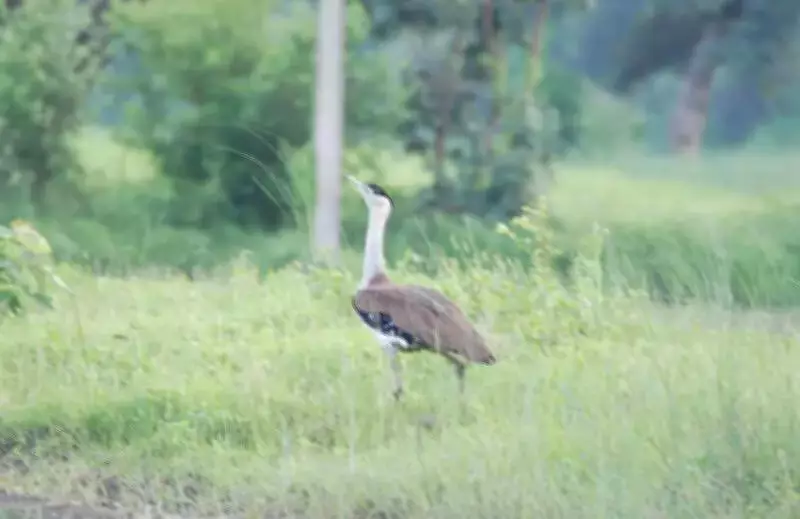
Great Indian Bustard Population Shows Encouraging Growth in 2025 Scientific Census
The Wildlife Institute of India (WII) has released the highly anticipated results of its comprehensive national-level scientific census of Schedule-I birds, with a particular focus on the critically endangered Great Indian Bustard, locally known as Godawan. Conducted in 2025 across the expansive Desert National Park (DNP) spanning Jaisalmer-Barmer districts and other plain areas of Jaisalmer, the census reveals encouraging outcomes for conservation efforts.
Significant Population Figures Revealed
The 2025 census data shows the Great Indian Bustard count in wild habitats, Desert National Park, and the army's Pokaran Field Firing Range stands at 130 ± 21 individuals. This represents a stable population compared to the 2017 WII census, which recorded 128 ± 19 birds in similar habitats. The most remarkable development comes from the breeding centers at Ramdevra and Sam, which together recorded 68 Great Indian Bustards in 2025. When combining all habitats and breeding centers, the total Great Indian Bustard population in the Jaisalmer region reaches 198 ± 21 birds.
"This represents significant progress," noted Deputy Conservator of Forest B M Gupta of Desert National Park. "In 2017, there were no Great Indian Bustards in breeding centers at all. The current figures showing 68 birds in controlled breeding environments is particularly encouraging for the species' long-term survival."

Comprehensive Census Methodology and Execution
The scientific census was conducted from April 7 to April 17, 2025, covering Desert National Park, the Pokaran Field Firing Range, and various Great Indian Bustard habitat areas throughout Jaisalmer. The survey employed Occupancy and Distance Sampling methodology across approximately 22,000 square kilometers over seven intensive days of fieldwork.
More than 200 volunteers and frontline wildlife workers participated through more than 50 specialized teams. Each team typically included a volunteer, forest ranger, and additional personnel to ensure comprehensive coverage and accurate data collection.
Extensive Training and Coordination
Prior to the census, a comprehensive 2-day training programme was organized to prepare participants. This training brought together scientists from WII, 50 volunteers from Gujarat, Maharashtra, Pune, Bengaluru, and Rajasthan, along with more than 200 additional volunteers, forest officers, and rangers.
The census was conducted under the guidance of Suthirto Datta, coordinator of the Great Indian Bustard breeding and conservation centre in Jaisalmer and a recognized Great Indian Bustard specialist. This marked the first comprehensive Godawan census in Jaisalmer in eight years, following the previous survey in 2017.
Strategic Survey Areas and Conservation Significance
Seven specific ranges were identified for the census: Myajlar, Sudasari, Ramgarh, Mohangarh, Rasla, Ramdevra, and Pokaran. Deputy Conservator Gupta emphasized the census's critical importance, noting that approximately 70 percent of the world's Great Indian Bustard population is found in the Jaisalmer region.
"Various conservation schemes are showing positive results for this endangered species," Gupta stated. "Special arrangements were made for this wildlife census, which was conducted under a well-organized plan with scientific rigor."
Methodological Advancements in Census Taking
The forest department traditionally conducts annual Godawan censuses on Vaishakh Purnima using the water hole method, which records wildlife visiting various water points. However, WII has developed a more sophisticated approach that divides the Godawan's range area into different blocks for more accurate scientific assessment.
"The scientific methodology employed in this census provides more reliable data than traditional methods," explained Gupta. "This comprehensive approach gives us a clearer picture of population distribution and habitat utilization."

The encouraging results from the 2025 census demonstrate that conservation efforts for the Great Indian Bustard are yielding measurable benefits, particularly through successful breeding programs that are supplementing wild populations. The stable wild population combined with growing numbers in breeding centers offers hope for the long-term recovery of this critically endangered species.





