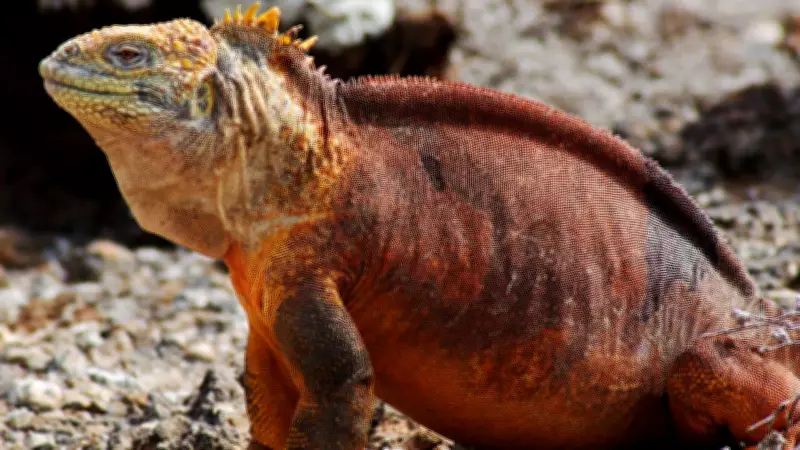
Across the dry volcanic landscapes of the Galápagos Islands, a large yellow reptile spends its days feeding beneath cacti, basking on sunlit rocks and quietly reshaping the environment around it. The Galápagos land iguana may not receive the same attention as the islands' giant tortoises, yet conservationists increasingly view it as one of the archipelago's most influential native species.
Distribution and Habitat
According to information published by the Galapagos Conservation Trust, the species is one of three land iguanas found nowhere else on Earth except the Galápagos Islands. Its range extends across several islands, including Fernandina, Isabela, Santa Cruz, South Plaza, Baltra, North Seymour and Santiago.
Size, Weight and Physical Features
The Galápagos land iguana (Conolophus subcristatus) is among the largest reptiles in the archipelago. Adults typically reach about one metre in length, though some individuals can grow to around 1.5 metres and weigh more than 11 kilograms. Its appearance is striking. Yellow skin mottled with darker patches helps distinguish it from other reptiles living on the islands. Powerful hind legs and sharp claws allow it to move efficiently across rocky ground, while its sturdy frame reflects a life spent navigating some of the Galápagos' driest habitats. BBC Wildlife reports that these iguanas are primarily herbivorous despite their formidable appearance. Much of their diet comes from vegetation, particularly prickly pear cacti, which also provide an important source of moisture in an environment where fresh water is often scarce.

Ecosystem Engineer
Conservation organisations frequently describe land iguanas as ecosystem engineers. The term refers to animals whose daily activities influence the structure and function of entire habitats. As they travel across the landscape, land iguanas consume fruits and vegetation before dispersing seeds elsewhere. Their movement through the soil and vegetation can create conditions that benefit plant growth and support other wildlife. The reptiles help thin dense vegetation, disturb compacted ground and spread seeds. These actions may appear insignificant on a small scale, yet over time they contribute to the health of entire island ecosystems. For that reason, protecting the species is viewed as more than simply preserving a reptile. It also means safeguarding ecological processes that affect many other plants and animals.
Reproduction and Lifespan
One of the more unusual sights in the Galápagos involves small finches perched on the backs of land iguanas. According to the Galapagos Conservation Trust, the birds feed on ticks and parasites hidden between the reptile's scales. The finches gain a food source, while the iguanas benefit from the removal of unwanted parasites. The interaction is a rare example of two very different animals benefiting from one another in everyday life. Reproduction requires patience. Female land iguanas may travel considerable distances in search of suitable nesting areas before burying their eggs underground. BBC Wildlife states that females typically lay around 20 eggs, which remain buried for approximately 85 to 110 days before hatching. Even after emerging from their shells, young iguanas face another challenge, often spending several days digging their way to the surface. Growth is equally gradual. Individuals may take between eight and fifteen years to reach maturity, making population recovery a slow process whenever numbers decline. Those who survive can enjoy remarkably long lives. The Galapagos Conservation Trust lists an average lifespan of around 55 years, while some animals are known to reach approximately 60 years of age.
Population Decline
The species has experienced a substantial decline over the past 150 years and is currently classified as Vulnerable. According to the Galapagos Conservation Trust, introduced animals, including cats, dogs, pigs and rats, have placed significant pressure on land iguana populations. Eggs and young animals are particularly vulnerable to predation, while competition for resources can further reduce survival rates. Some island populations disappeared entirely. On Santiago Island, land iguanas became locally extinct during the twentieth century. Their absence lasted for decades.

Conservation and Recovery
One of the most significant recent conservation efforts in the Galápagos has centred on bringing the species back to Santiago. The Galapagos Conservation Trust reports that more than 1,000 land iguanas were initially reintroduced to the island in 2019 as part of a broader ecological restoration programme. More than 5,000 individuals have since been released. The objective extends beyond restoring a lost population. Conservationists hope the reptiles will help rebuild ecological functions that disappeared when the species vanished from the island. By spreading seeds, influencing vegetation and altering soil conditions through their daily activities, the returning iguanas are once again becoming part of Santiago's natural processes. The story of the Galápagos land iguana is closely tied to the wider story of restoration across the archipelago. Once reduced by invasive species and habitat disruption, the reptile is now helping repair some of the very ecosystems that support it. The species demonstrates how a single native animal can influence an entire landscape. Its recovery is not simply about increasing numbers. It is also about restoring ecological relationships that have shaped the Galápagos Islands for thousands of years.