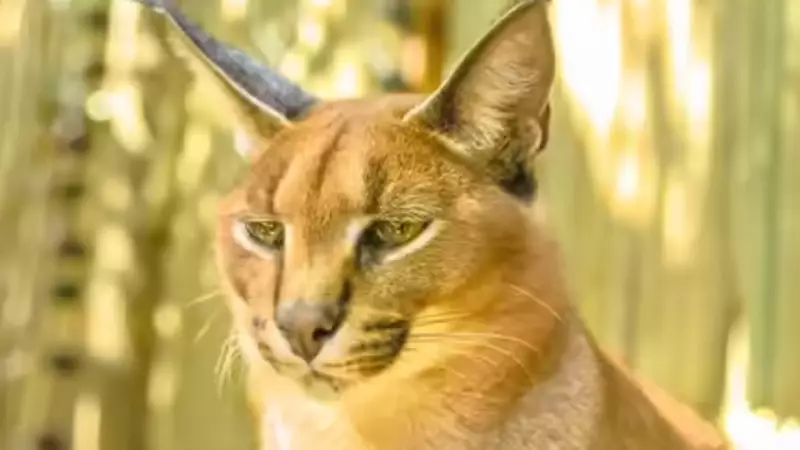
Historic Conservation Milestone: First Radio Collar on Endangered Caracal in India
In a groundbreaking achievement for wildlife conservation in India, forest officials in Rajasthan's Jaisalmer district have successfully fitted a radio collar on an endangered caracal cat for the very first time in the country. This pioneering move is expected to yield vital data on the elusive wild cat's movements, behavior, and ecology, significantly enhancing conservation strategies.
Rescue Operation and Scientific Collaboration
The operation commenced after forest department officials received critical information on Sunday night that a caracal had been ensnared in a net, allegedly laid by local poachers, in Ghotaru village near Shahgarh Gram Panchayat in the border region. A rapid response team immediately rushed to the location and safely rescued the animal.
Under the expert guidance of Chief Conservator of Forests (CCF) Jodhpur, Anoop K. R., a joint team from the Rajasthan Forest Department and the Wildlife Institute of India (WII) conducted the rescue. The team performed comprehensive health and safety checks on the male caracal, fitted it with a specialized radio collar, and subsequently released it back into its natural habitat. Officials emphasized that this night-time exercise was executed with strict adherence to scientific protocols and utmost caution, with WII experts actively participating throughout the rescue, collaring, and release processes.

Official Endorsements and Conservation Context
Rajasthan's Forest, Environment and Climate Change Minister, Sanjay Sharma, confirmed this significant development in a post on social media platform X, hailing it as a major conservation achievement. CCF Anoop K. R. provided further details, noting that the caracal had been trapped on January 23 and was promptly recovered by the department.
The Rajasthan Forest Department is currently implementing a dedicated caracal conservation programme in collaboration with WII and the non-governmental organization Tiger Watch, focusing on the Sawai Madhopur and Karauli districts. Conservationists have also urged the state to consider initiating a conservation breeding programme for this rare and critically endangered species to bolster population recovery efforts.
Addressing Knowledge Gaps Through Technology
Officials highlighted that information on caracals in India remains severely limited due to their secretive and predominantly nocturnal behavior. To bridge this knowledge gap, the department, under the direction of Chief Wildlife Warden KCA Arunprasad and Principal Chief Conservator of Forests (HoFF) PK Upadhyay, decided to monitor the rescued animal using a radio collar to study its habits in the wild comprehensively.
A dedicated research team has been formed to track the animal and document its behavior and ecology. This team operates under the leadership of Assistant Conservator of Forests (ACF) Ranjit Singh Dholia of IGNP Jaisalmer, alongside WII scientists Dr. Sutirtha Dutta, Dr. Moibuddin, and Dr. Tushna Karkaria. The radio collar was provided by Dr. Bilal Habib of WII.
Technical Aspects and Tracking Methodology
The radio collar emits signals that enable precise location tracking of the animal. According to the forest department, location data will be transmitted every four hours to the registered email of CCF Jodhpur, while movement information will be received continuously. Additionally, VHF signals from the collar can be detected using a handheld receiver within an approximate range of five kilometers, facilitating real-time monitoring.
Ecological Insights and Habitat Concerns
Wildlife biologist Dr. Sumit Dookia provided ecological context, stating that the Ghotaru landscape is a known habitat for caracals, which prefer bushy terrain and are primarily nocturnal hunters, making sightings exceptionally rare. He noted that the species is distributed across parts of Africa, the Middle East, Central Asia, and in dry regions of Pakistan and north-west India. Dr. Dookia also called for stronger protection of the caracal's fragile habitat, warning against threats such as large-scale solar projects that could disrupt their ecosystem.

Officials expressed optimism that the tracking study will deliver vital inputs for strengthening caracal conservation efforts in Rajasthan, paving the way for more informed and effective wildlife management practices.