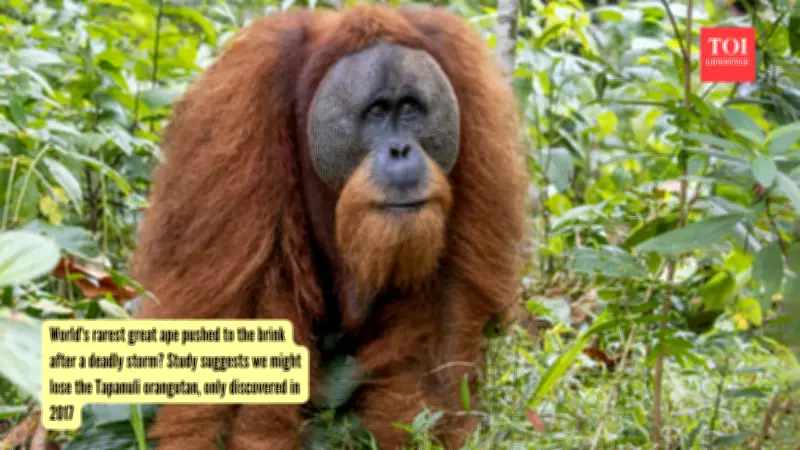
Some species have been known to mankind for thousands of years. Others were discovered only recently. The Tapanuli orangutan belongs to the second group and was recognized as a distinct kind of great ape only in 2017. However, a recent event has put this species at grave risk, with experts warning it might not survive for long.
Four Days of Rain Pushed the Planet's Rarest Great Ape to the Edge
A few days of catastrophic weather may have erased what little safety margin existed for the Tapanuli orangutan, the rarest great ape on the planet. A new study reveals that approximately 58 of these critically endangered apes were killed when Cyclone Senyar battered the Indonesian island of Sumatra with four days of relentless rain last November. This represents about 7% of the entire species, leaving fewer than 800 individuals worldwide.
The number is even more alarming because it is a cautious estimate. As the researchers behind the study, published in the journal Current Biology, explain, it only counts the apes known to have died in the storm. It does not include those that may die later due to the wrecked forest and lost fruit trees, which leave survivors with diminishing food sources. Thus, the true loss could be even worse.

The Orangutans Died Brutally
The study states that the apes drowned, were buried under landslides, or were struck by collapsing trees as entire hillsides gave way. Professor Erik Meijaard of Borneo Futures in Brunei, one of the study's authors, initially told the BBC in December that the cyclone probably killed around 35 apes. The fuller analysis turned out to be nearly double that. Reviewing photographs of a dead orangutan, Meijaard described how even these famously powerful animals are left helpless when a forested slope crashes down on them.
The human cost was also immense. Cyclone Senyar killed more than 1,000 people, making it Southeast Asia's deadliest natural disaster of 2025. Humanitarian workers were among the first to sense the impact on wildlife. One of them, Deckey Chandra, told the BBC that a spot where the apes once gathered to eat fruit "now seems to have become their graveyard."
The Maths Is Frightening
Studies show the Tapanuli orangutan is in real danger of extinction if it loses even 1% of its population annually. This single storm wiped out 58 individuals at once, about 7% of the entire species and roughly 11% of the orangutans living in the affected area. That loss is many times greater than the species can withstand, and researchers say it is simply too large for them to recover from.
The team notes that Cyclone Senyar was an unusual storm, but they also attribute its severity to climate change caused by human impact. They warn that such extreme rainfall is likely to occur more frequently. Jatna Supriatna of the University of Indonesia called the deaths "a devastating demographic shock to the world's rarest great ape," as reported by AFP.