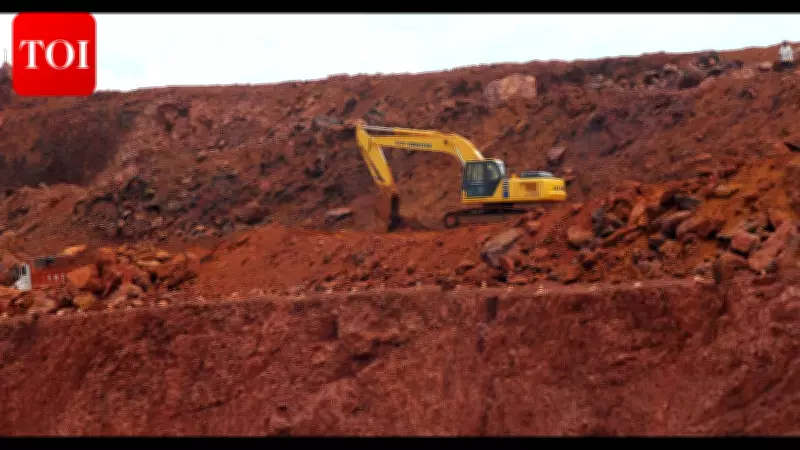
Bihar has entered the country's rare minerals race with the discovery of significant reserves of rare earth elements (REEs) and strategic minerals in at least seven districts: Bhagalpur, Gaya, Aurangabad, Banka, Jamui, Nawada, and Rohtas. The findings have raised expectations that the state, long dependent on agriculture, could soon become an important player in India's emerging minerals sector.
Large-Scale Mining Operations Expected
As Bihar prepares for large-scale mining operations involving around a dozen minerals and rare earth elements over the next few years, the implications extend beyond the mining industry. The development is expected to generate thousands of direct and indirect jobs, strengthen local economies, and potentially reduce migration by creating employment opportunities within the state.
Global Significance of Rare Earth Elements
The discovery assumes greater significance at a time when countries worldwide are competing to secure supplies of rare earth elements and strategic minerals essential for modern technology, renewable energy systems, electric vehicles, and defence manufacturing. India holds the world's third-largest rare earth element reserves, accounting for nearly 6%-7% of global resources. However, it ranks seventh globally in production, producing around 2,900 tonnes of REEs. China continues to dominate the sector, controlling more than 70% of global production and nearly 90% of refining capacity. Indian reserves are largely lean and concentrated in coastal monazite sands associated with radioactive materials, making extraction complex and costly.

Geological Transformation in Southern Bihar
Former Geological Survey of India (GSI) director P K Sinha said Bihar's mineral profile has changed considerably in recent years. For decades, the state was known primarily for coal and limestone deposits. However, extensive G1 and G4-level explorations carried out by the GSI and the state mines department have transformed the southern districts into an important zone for critical minerals and rare earth elements. Sinha noted that rare earths today control the world economy, adding: "The richer a country is in rare earths, the more powerful it is."
Understanding Rare Earth Elements
REEs are a group of 17 naturally occurring metallic elements essential in more than 200 modern products. Although relatively abundant in the Earth's crust, they are rarely found in highly concentrated and economically viable deposits. The group includes Lanthanum, Cerium, Praseodymium, Neodymium, Promethium, Samarium, Europium, Gadolinium, Terbium, Dysprosium, Holmium, Erbium, Thulium, Ytterbium, Lutetium, Scandium, and Yttrium. The Atomic Minerals Directorate of Exploration and Research is conducting radiometric surveys and geological mapping in the Nawada region. Some of these rare earth elements have already been identified in Bihar.
Geological Formations Hosting REEs
According to geoscientists associated with the GSI, recent surveys have revealed that REEs are primarily associated with Archean metamorphic rocks, particularly granite pegmatites and migmatitic gneisses. These geological formations belong to the Chotanagpur Granite Gneissic Complex (CGGC) and are predominantly found in southern districts such as Nawada, Gaya, Jamui, Bhagalpur, and Banka. Granite pegmatites occurring extensively in the Bihar Mica Belt, especially in Nawada and Bhagalpur, contain rare metal-bearing minerals such as columbite-tantalite and beryl. The region's migmatitic gneiss and granitoid formations also host valuable REE-bearing minerals including allanite, xenotime, monazite, and bastnasite.
Additional Mineral Discoveries
Investigations have further identified traces of critical minerals and rare earth elements in weathered rocks and deep-seated formations. While REE traces have been mapped in Bateshwarsthan in Bhagalpur district, cobalt and copper occurrences have been identified in the quartzites and schists of Banka district. The state government has also reported signs of gold in Jamui and vanadium-bearing magnetite in Nawada. In addition, Rohtas district, known for possessing the largest pyrite deposits in India, contains substantial reserves of glauconite, according to mines and geology minister Pramod Kumar.

Government Plans and Economic Impact
The minister said the state's mines and geology department, working in collaboration with the central government, is targeting these deposits to strengthen the local economy and support India's transition towards green energy. He stated that final-stage G1 exploration activities have already begun and multiple mineral blocks containing critical minerals are expected to be opened for commercial auction and large-scale mining operations. Official sources estimate the tentative value of Bihar's critical minerals and rare earth element reserves at between Rs 14,325 crore and Rs 14,594 crore. The valuation covers a range of newly identified strategic minerals, critical metals, and base ores.
Employment and Local Development
Retired GSI deputy director general Binod Kumar observed that mining operations in districts such as Gaya, Rohtas, and Banka could create thousands of direct employment opportunities for skilled and unskilled workers. He said mineral auctions and extraction activities would also generate substantial royalty income and district mineral foundation (DMF) funds for the state. These funds are legally mandated for local development and can improve roads, drinking water infrastructure, and healthcare facilities in mining-affected areas. Kumar further pointed out that huge glauconite (potash) reserves found in Rohtas could provide a significant boost to agriculture. These deposits can serve as natural, slow-release fertilisers, helping farmers reduce dependence on expensive chemical fertilisers, improve organic crop yields, and lower cultivation costs.