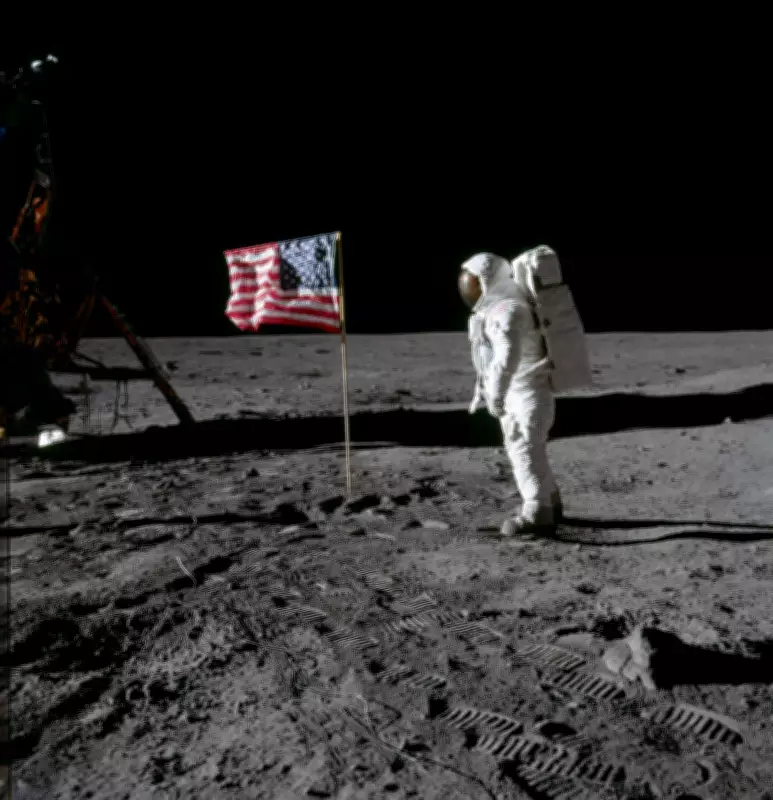
When we think of milestones in space travel, one image stands out above the rest. A bold astronaut dressed in an oversized white spacesuit skillfully planted an American flag, colored in red, white, and blue, on the grey surface of the moon. It was an achievement captured forever in photographs. But out there in the silent vacuum of deep space, time does not actually stand still. Over time, the harsh lunar environment has been wearing down these historic monuments.
The Harsh Reality of Lunar Exposure
According to a report published by Space Daily, those iconic colored banners have undergone a radical transformation. The report says more than 50 years of intense solar radiation likely stripped the flags of their colour, leaving them white. The extreme toll of unfiltered solar radiation is the primary culprit.
How Solar Radiation Faded the Colors
To understand how a symbol of national pride turns into a plain white sheet, you have to look at the unique everyday conditions of the lunar surface. On Earth, our thick atmosphere acts like a protective blanket, filtering out much of the sun’s harmful radiation. Fabrics outside our homes might fade over a few summers, but they are largely shielded from the worst of cosmic weather. The moon has no such defence system, and without a protective atmospheric shield, the lunar surface is constantly blasted by intense ultraviolet light and high-energy solar winds, as per NASA. For standard dyed nylon, this environment is an absolute nightmare. Space Daily explains that high-energy ultraviolet photons act like microscopic scissors, breaking the chemical bonds that give the dyes their colour. Through years of non-stop exposure, the chemical process of fading takes away the colours red and blue, leaving only the fibre behind.

Extreme Temperature Swings Weaken the Fabric
The flags also faced extreme temperature swings that can weaken nylon over time. One full day on the moon takes around fourteen days on Earth, where the surface gets heated up to temperatures as high as 120 degrees centigrade. As the Space Daily article notes, this constant thermal cycling can cause the fabric to weaken over time. The flags used during the Apollo missions were not engineered out of exotic space-age materials, according to NASA. They were off-the-shelf nylon banners purchased for a few dollars, chosen simply because they were lightweight and easy to pack. Repeated heating above nylon’s flexibility limits during the day and freezing at night can cause microscopic fractures to spread through the weave. Threads that were once held tight have likely gone slack or snapped over the hundreds of day and night cycles that have passed since the landings.
Structural Resilience Despite the Damage
Despite the intense wear and tear, these historic artefacts have shown a surprising amount of structural resilience. Images from NASA’s Lunar Reconnaissance Orbiter show that the poles and horizontal crossbars are still standing at almost all the landing sites. The sole exception is the Apollo 11 flag, which was likely knocked down by the ascent engine exhaust during liftoff. All the other five flags remain standing tall and cast long shadows on the moon’s soil.
What Experts Believe About the Flags' Condition
Based on physics and materials science, it is highly unlikely that a commercial fabric would retain its original pigment after half a century in such an environment. Some experts think the flags may have faded to white, but the exact condition is not directly confirmed. While some people may find it sad that the iconic colours are gone, scientists see the blank white banners as a reminder of how harsh the lunar environment is. A colourful flag remaining pristine after fifty years in a vacuum would be a lie about the realities of space. The faded cloth reflects the Moon’s harsh environment and the way it can wear down objects over time.
While the flags may appear white now, they stand as a testament to the moon's unforgiving environment. Images show the flags' poles remain standing, a surprising resilience. Image Credits: NASA