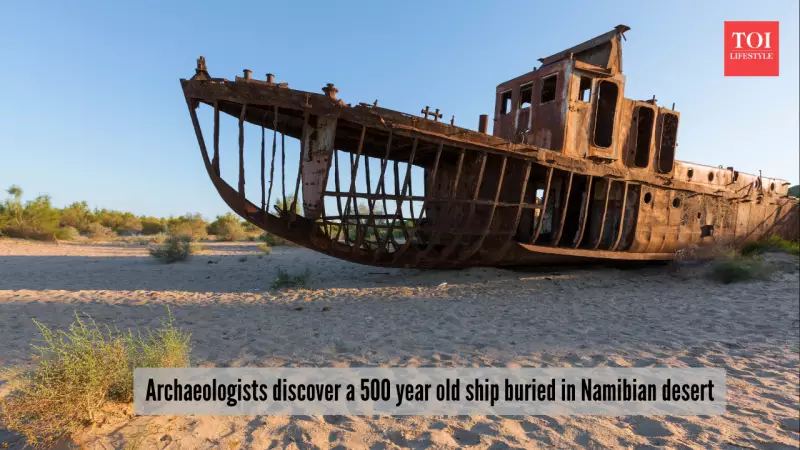
Imagine a vast, arid desert landscape, where endless golden dunes stretch to the horizon. Now, picture a massive ocean-going ship emerging from these sands. This is not a scene from a fantasy film but a stunning real-life discovery made in the heart of the Namib Desert.
The Accidental Discovery of a Renaissance Time Capsule
In 2008, workers for a diamond mining company were engaged in a routine operation near the coastal town of Oranjemund. They were pumping out seawater from a 200-meter stretch when their equipment struck something unexpected: ancient wooden timbers. What emerged from the dry earth was no mirage, but the remarkably preserved hull of a centuries-old ship.
Archaeologists from the University of Namibia and international teams rushed to the site. They identified the vessel as the Bom Jesus, a Portuguese carrack from the 16th century. The dry, salty sands of the desert had acted as a perfect preservative, creating a stunning time capsule from the Age of Exploration buried miles inland.

A Treasure Trove Frozen in Time
The excavation revealed a cargo that was like a pirate's ultimate fantasy. The haul included over 2,000 gold coins minted in Portugal, bearing the face of King John III and worth millions today. But the wealth did not stop there.
Researchers also recovered:
- Hundreds of kilograms of copper ingots.
- Numerous silver coins.
- Elephant tusks.
- Fragments of precious Ming Dynasty porcelain.
Incredibly, even perishable items like leather shoes and navigational tools such as astrolabes were found intact, with no sign of rot or rust. These were not stolen goods but legitimate trade items destined for India, showcasing the vast reach of Portuguese maritime trade routes.
A Fateful Voyage and Enduring Mystery
Historical records indicate the Bom Jesus was launched around 1533. It was a sturdy, three-masted carrack built to withstand long voyages to India in search of spices and wealth. However, its journey was cut short along one of the world's most treacherous coastlines.
Historians believe that in March 1533, the ship fell victim to a fierce storm and was dashed onto the reefs of what is now known as Namibia's Skeleton Coast—a notorious graveyard for ships. While up to 200 crew members were likely on board, not a single body or grave has been found at the site. The fate of the sailors—whether they perished at sea or attempted to trek inland—remains one of the desert's guarded secrets.
After a legal process, Portugal formally handed over the treasure to Namibia in 2018, where it is now displayed in museums. The Oranjemund wreck, as it is popularly known, is more than just a collection of valuables. It is a direct window into the perils and ambitions of 16th-century global trade, proving that history often lies hidden in the most unexpected places, waiting for a chance discovery.