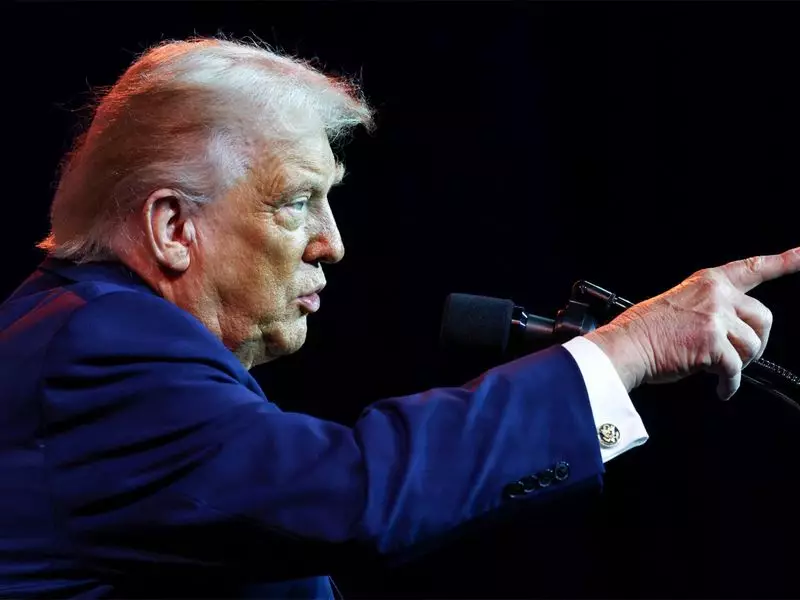
In a significant development for the global tech and semiconductor industry, former US President Donald Trump recently held a meeting with Intel's Chief Executive Officer, Pat Gelsinger. The high-profile discussion centered on America's push to reclaim leadership in advanced chip manufacturing, a sector dominated by Asia for decades.
A Celebration of American Chipmaking Breakthrough
The core of the meeting was the celebration of a major technological achievement. Intel has successfully developed a sub-2 nanometer (nm) semiconductor chip at its facilities in the United States. This cutting-edge processor represents the forefront of chip technology, promising greater power and efficiency for everything from data centers to personal devices.
Trump specifically hailed this "US-made" sub-2nm chip, framing it as a tangible result of policies aimed at revitalizing domestic manufacturing. The development is closely tied to Intel's massive expansion in Chandler, Arizona, where the company is investing tens of billions of dollars to build and upgrade fabrication plants (fabs). This move is a direct part of the broader strategy to reduce America's dependency on foreign semiconductor supply chains.

Linking Manufacturing Success to Tariff Policies
A key point emphasized by the former President was the connection between this industrial achievement and his signature trade policy. Donald Trump explicitly linked the push for advanced US chip manufacturing to his proposed tariff policy. He argued that imposing tariffs on imports, particularly from China, is essential to protect and encourage domestic production.
The logic presented is that tariffs level the playing field, making it more economically viable for companies like Intel to produce at home rather than offshore. This meeting, therefore, served as a platform to reinforce the argument that protective trade measures are not just about economics but are crucial for national security and technological sovereignty.
Implications for Global Tech and India's Role
This development has wide-ranging implications. For the global technology landscape, a resurgent US semiconductor sector could alter supply chain dynamics and increase competition with foundry giants like Taiwan's TSMC and South Korea's Samsung.
For India, which is aggressively courting semiconductor investments under its Production Linked Incentive (PLI) scheme, the US push presents both challenges and opportunities. While it underscores the fierce global competition for high-tech manufacturing, it also validates the strategic importance of the sector. India's own ambitions to become a chip-making hub will need to navigate this reshaped geopolitical and industrial context, where national policies like tariffs and subsidies are becoming decisive tools.
The meeting between Trump and Gelsinger is more than a photo-op; it is a symbol of the intense geo-technological rivalry defining the current era. As the US doubles down on bringing chip fabrication home, the decisions made in Washington and boardrooms will ripple through markets worldwide, affecting pricing, availability, and the future direction of innovation in electronics and computing.