

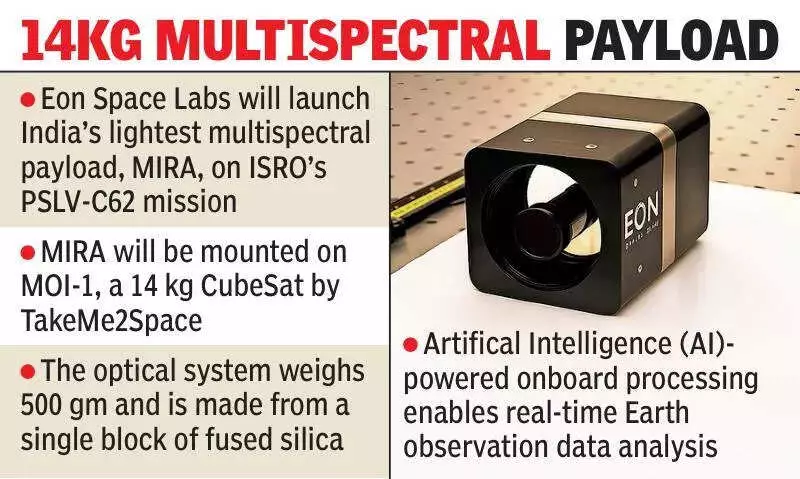
In a significant leap for India's private space sector, a Hyderabad-based deeptech startup is poised to launch a groundbreaking imaging instrument aboard an Indian Space Research Organisation (ISRO) rocket. Eon Space Labs has developed what it claims is India's lightest advanced multispectral Earth imaging payload, named MIRA. This innovative technology is scheduled for launch into space on January 12.
Mission Details and Collaborative Effort
The launch will take place from the Satish Dhawan Space Centre at Sriharikota on board ISRO's PSLV-C62 mission. The MIRA payload will be mounted on a satellite called MOI-1, which is a 14 kg CubeSat developed by another Hyderabad-based spacetech firm, TakeMe2Space. This collaboration highlights the growing ecosystem of private space companies in India.
MIRA represents a feat of miniaturization in optical engineering. Weighing approximately 500 grams, the multispectral telescope has been carved from a single block of fused silica. This unique construction method provides enhanced stability and reduces vibration sensitivity, ensuring high-quality imaging from a very compact device. The payload has been integrated with MOI-1's onboard computing system, which is the key to its revolutionary function.

AI-Powered Orbital Intelligence: A Paradigm Shift
The core objective of this mission is to demonstrate the viability of India's first AI-powered orbital image laboratories. Unlike traditional Earth observation satellites that capture images and send vast amounts of raw data back to Earth for processing, MIRA's mission is different. Its integrated system will enable AI models to analyse image data while the satellite is still in orbit.
This capability for near real-time, in-orbit processing is a game-changer. It means the satellite can generate actionable insights and send only the valuable, processed information to ground stations. Sanjay Kumar, co-founder of Eon Space Labs, emphasized the shift this represents. He stated that this approach moves beyond mere image capture to generating insights in orbit, with profound implications for the cost, speed, and accessibility of space-based intelligence.
Implications for the Future of Earth Observation
The successful demonstration of this technology could significantly lower data downlink costs for Earth observation missions. By processing data in space, the need to transmit massive, unprocessed files is eliminated, saving bandwidth and time. This makes detailed Earth observation more efficient and potentially more accessible for various applications, including agriculture, urban planning, disaster management, and environmental monitoring.
The January 12 launch marks a critical milestone for India's private space industry, showcasing homegrown innovation in miniaturized payloads and orbital AI processing. The eyes of the nation's tech and space communities will be on Sriharikota as this Hyderabad-born innovation takes to the skies, aiming to redefine how we gather intelligence from space.






