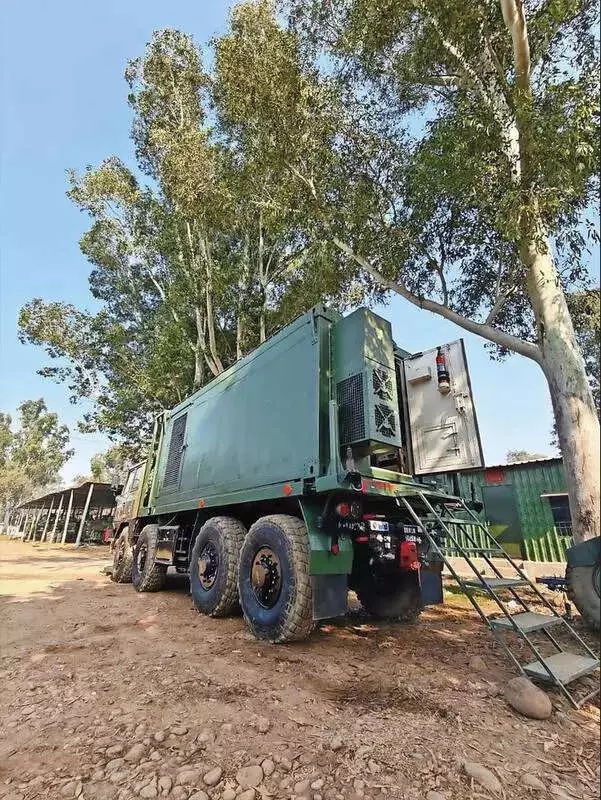
In a significant boost to India's indigenous defense technology, a unique startup incubated in a Hyderabad hostel has delivered a groundbreaking mobile drone laboratory to the Indian Army. This innovative facility, developed by Apollyon Dynamics, is designed to manufacture and repair crucial first-person view (FPV) drones right at the frontline, dramatically reducing logistical delays.
From Dorm Room to the Frontline: The Student Entrepreneurs' Journey
The mobile lab is the brainchild of two 20-year-old student entrepreneurs from the BITS Pilani campus in Hyderabad. They founded Apollyon Dynamics just six months before receiving the pivotal request from the Army during their third-year first-semester exams. The challenge was to create a mobile unit capable of supporting drone operations in active zones. Remarkably, the duo, Jayant Khatri and Sourya Choudhury, designed and delivered the operational lab within an astonishing 15 to 20 days.
Jayant Khatri, the CEO of Apollyon Dynamics, revealed that the Army approached them with the concept for this mobile unit. The startup had already gained attention in July 2025 for supplying kamikaze drones to the armed forces. The newly developed lab, built onto the back of an Army truck, is now operational in Jammu. Khatri emphasized that while the lab uses a mix of indigenous and imported components, specific technical details remain confidential for security reasons.

How the Mobile Drone Lab Transforms Battlefield Logistics
This one-of-a-kind facility functions as a complete moving workshop that can be deployed wherever the situation demands, even just kilometers away from active combat zones. Once stationed, it allows soldiers to assemble, repair, and prepare drones for immediate missions. The most critical advantage is the drastic reduction in replacement time. "The Army can now replace lost drones in hours instead of waiting for days or weeks, keeping pace with the fast-changing realities of modern warfare," Khatri explained.
The lab's capabilities are comprehensive. It includes a 3D printer for manufacturing drone frames on-site, dedicated assembly units, and a ground station. This setup empowers troops to manufacture drones from scratch near the borders. According to the founders, such advanced mobile drone manufacturing capability is currently available only in a few countries, including Russia and Ukraine.
Empowering Soldiers and Creating a Strategic Edge
Beyond the mobile unit, Apollyon Dynamics has also assisted the Army in establishing a permanent drone lab within a regiment's premises in Jammu. This fixed facility handles equipment storage, larger-scale assembly, training, and maintenance. Together, the mobile and permanent labs create a powerful dual-system: one provides agile, frontline support that moves with the troops, while the other offers a stable base for continuous, sustained operations.
The initiative's core innovation lies in transferring manufacturing knowledge directly to the soldiers. Sourya Choudhury, the Chief Technology Officer who is still in his third year of engineering, highlighted this strategic shift. "What sets this apart is that it puts drone manufacturing directly in the hands of soldiers. Instead of depending on long supply chains, troops are trained to assemble and maintain their own drones," he said. This allows for rapid modifications based on real-time battlefield feedback, creating a crucial tactical advantage.
The Army has formally appreciated the startup's work. In an official letter, they commended the lab for meeting all required quality and performance standards, enabling the assembly, soldering, and programming of FPV drones. The letter praised the firm's "professional approach, technical competence, and commitment." This project stands as a testament to how student-led innovation from Indian campuses can directly contribute to national security and technological self-reliance.