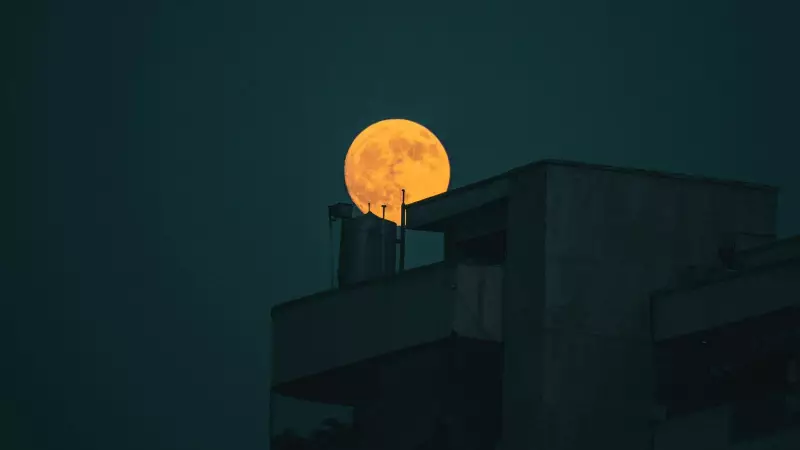
For astronomy enthusiasts and casual stargazers across India, the year 2026 is shaping up to be an extraordinary one. The celestial calendar is packed with a series of breathtaking lunar events that will dominate the night sky. From dramatic eclipses and rare planetary conjunctions to a record-close supermoon, the moon will be the undeniable star of the show, offering numerous opportunities for observation with the naked eye, binoculars, or telescopes.
A Year of Eclipses and Cosmic Alignments
The astronomical lineup for 2026 features a mix of solar and lunar eclipses, along with stunning meetings between the moon and planets. The year will kick off with a visual treat on January 3, 2026, as the Wolf Moon rises as the first supermoon of the year. This event will appear noticeably larger and brighter, marking the beginning of a trio of supermoons scheduled for the year.
Following this, a dramatic "Ring of Fire" annular solar eclipse will occur on February 17, 2026. During this event, the moon will obscure up to 96% of the Sun's centre, leaving behind a glowing ring of light. The full annular phase will be a rare sight, visible only from remote Antarctic research stations, while a partial eclipse will be seen from Antarctica, parts of southern Africa, and Argentina.

Just a day later, on February 18, skywatchers can look for a razor-thin crescent moon positioned close to the elusive planet Mercury low in the western sky just after sunset. This delicate pairing, with the moon only about 2% illuminated, will be best spotted with binoculars, with Venus and Saturn also visible in the vicinity.
The first major lunar spectacle will be a "Blood Moon" total lunar eclipse on the night of March 2-3, 2026. This will be the final total lunar eclipse in a series of three, with the previous two occurring in 2025. The full Worm Moon will pass into Earth's shadow, turning a reddish-orange hue for approximately 58 minutes. This event will be visible from western North America, Australia, New Zealand, East Asia, and the Pacific region.
Planetary Encounters and Stellar Gatherings
As the year progresses, the moon will engage in a beautiful dance with bright planets and star clusters. On March 20, a young, 5%-lit waxing crescent moon will hang above the brilliant planet Venus about 45 minutes after sunset, offering a perfect photo opportunity against a clear western horizon.
A month later, on April 19, an hour after sunset, a 9%-lit crescent moon will approach the famous Pleiades star cluster, also known as the "Seven Sisters." The scene will be further enhanced by the bright glow of Venus positioned below this cosmic trio.
The most dramatic solar event of the year will be a total solar eclipse on August 12, 2026. The moon will completely hide the sun for up to 2 minutes and 18 seconds for observers in eastern Greenland, western Iceland, and northern Spain. While not visible from India, a deep partial eclipse will be seen across all of Europe, and a minor partial eclipse will be visible from North America.
A partial lunar eclipse will follow later in the year, visible from North and South America, Europe, and Africa. While not a total eclipse, it will still present a captivating sight as the edge of Earth's shadow moves across the lunar surface.
The moon will also cozy up to star clusters and planets in quieter events. On September 8, a waning crescent moon will sit right above the Beehive Cluster before dawn. Later, on September 26, the moon will pass close to Saturn in the night sky. A particularly rare and close conjunction will occur between a crescent moon and Jupiter, with a mere 10 arc seconds separating the two, best viewed in the east before sunrise.
By November, Mars will become visible in the pre-dawn sky, and on November 2, a 43%-lit waning crescent moon will approach the Red Planet, with Jupiter shining slightly below.

The Grand Finale: A Record-Breaking Supermoon
The year will conclude with a celestial highlight that promises to be the most impressive lunar event of 2026. While supermoons will occur on January 3, November 24, and December 23, the one on December 23 stands out. It will be the closest full moon to Earth since 2019.
At a distance of just 221,668 miles (356,740 km), it will come about 60 miles (100 km) closer than the supermoon of February 19, 2019. This proximity will make it the largest and brightest full moon observed in nearly eight years. However, this record will be short-lived, as even closer supermoons are predicted for February 2028 and March 2029.
For Indian stargazers, planning is key. While not all events will be fully visible from the subcontinent, many of the planetary conjunctions and supermoons will be. Identifying a location with minimal light pollution and a clear horizon will significantly enhance the viewing experience for these spectacular lunar performances slated for 2026.