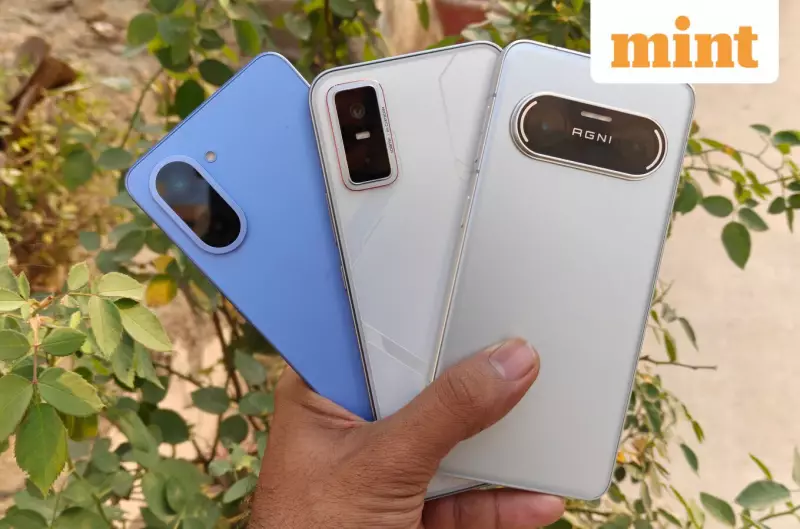
Indian smartphone brand Lava has officially launched its latest flagship device, the Agni 4, in the competitive sub-₹25,000 price segment. The new smartphone features a premium design and is powered by MediaTek's Dimensity 8350 processor, positioning itself as a strong contender against established rivals like the OnePlus Nord CE 5 and Infinix GT 30 Pro.
Design and Build Quality Comparison
The Lava Agni 4 distinguishes itself with an aluminum frame and a distinctive horizontal camera module that gives it a premium appearance despite its mid-range pricing. The device features a glass back with muted color options that contribute to its flagship-like aesthetic. Meanwhile, the Infinix GT 30 Pro, despite its plastic construction, makes a strong visual statement with RGB lighting that provides notification alerts and music synchronization features. It also includes dedicated shoulder triggers specifically designed for gaming enthusiasts.
The OnePlus Nord CE 5 adopts a more conventional design approach compared to its competitors, though it compensates with superior durability. The Nord CE 5 boasts an IP65 water and dust resistance rating, which is slightly better than the IP64 rating shared by both the Agni 4 and GT 30 Pro.

Display and Performance Specifications
All three smartphones feature AMOLED displays, but with notable differences in quality and capabilities. The Lava Agni 4 and Infinix GT 30 Pro both utilize higher-resolution 1.5K panels, while the OnePlus Nord CE 5 settles for a Full HD+ display. The Infinix GT 30 Pro takes the display game further with a 144Hz refresh rate, making it particularly appealing for gaming applications. All three devices offer excellent outdoor visibility with high brightness levels reaching up to 4500 nits on the GT 30 Pro.
Under the hood, all three phones are powered by variants of MediaTek's Dimensity 8350 processor, with minimal performance differences between them. The Dimensity 8350 proves to be a capable chipset that handles everyday tasks and intensive gaming with equal proficiency. All devices support LPDDR5X RAM, though the Nord CE 5 falls behind with slower UFS 3.1 storage compared to the UFS 4.0 storage found in both the Agni 4 and GT 30 Pro.
Battery, Software and Camera Analysis
The battery department reveals significant differences between the three contenders. The OnePlus Nord CE 5 dominates with a massive 7,100mAh battery supported by 80W fast charging, completely overshadowing the Agni 4's 5,000mAh battery with 66W charging and the GT 30 Pro's 5,500mAh battery with 45W charging.
Software experience varies considerably across the three devices. OnePlus leads with its fluid OxygenOS 15 based on Android 15, backed by an impressive update promise of four OS updates and six years of security patches. The Infinix GT 30 Pro runs XOS 15 on Android 15 but offers only two OS updates and three years of security support. The Lava Agni 4 features stock Android 15 but comes from a manufacturer with a less established track record for software updates, promising three OS updates and four years of security patches.
Camera capabilities present another area of differentiation. The Infinix GT 30 Pro leads on paper with a 108MP main sensor, while both the Agni 4 and Nord CE 5 feature 50MP primary cameras with optical image stabilization. OnePlus's camera tuning typically delivers reliable results in this price segment, though the Agni 4's camera performance remains to be thoroughly tested.
Which Phone Offers the Best Value?
For hardcore gaming enthusiasts, the Infinix GT 30 Pro emerges as the top recommendation due to its gaming-focused features including shoulder triggers, high refresh rate display, and gaming-optimized software. However, users must compromise on charging speeds and battery capacity compared to the Nord CE 5.
Users prioritizing battery life and reliable camera performance will find the OnePlus Nord CE 5 to be an excellent choice, despite its lower resolution display and slower storage speeds. The device's massive battery and proven software experience make it a safe bet for most users.

The Lava Agni 4 appeals particularly to design-conscious consumers who value premium build materials and clean software experience. However, it requires compromises in battery capacity and lacks some features available in competing devices.
The sub-₹25,000 smartphone segment in India continues to offer compelling choices catering to different user preferences, with each of these three devices bringing unique strengths to the table. Your final choice should depend on whether you prioritize gaming performance, battery endurance, or design aesthetics.