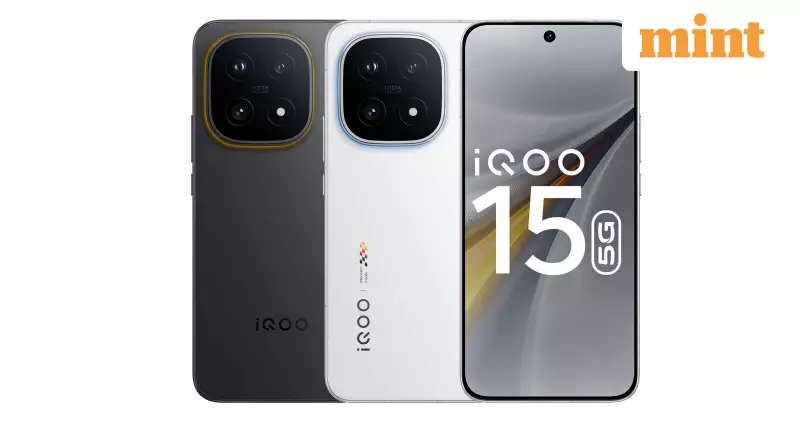
The Indian premium smartphone market witnessed a major showdown this Wednesday as iQOO officially launched its highly anticipated iQOO 15, powered by the formidable Qualcomm Snapdragon 8 Elite Gen 5 chipset. This new flagship enters a fiercely competitive arena, directly challenging rivals like the OnePlus 15 and the Realme GT 8 Pro, with each brand taking distinct approaches to performance, battery life, and camera technology.
Price and Availability: A Battle of Introductory Offers
At first glance, the pricing structures for the iQOO 15 and OnePlus 15 are identical. Both phones start at ₹72,999 for the 12GB RAM and 256GB storage variant, while the higher-end model with 16GB RAM and 512GB storage is priced at ₹79,999. However, the effective price for early buyers differs significantly due to launch offers.
Prospective iQOO 15 buyers can benefit from a substantial instant bank discount of ₹7,000, effectively reducing the entry price to an attractive ₹64,999. On the other hand, OnePlus 15 offers a smaller bank discount of ₹4,000, bringing its starting price down to ₹68,999. Both devices will be available for purchase on Amazon, though iQOO is granting early access to its sales for customers with a Priority Pass.

Display, Design, and Performance Showdown
The two smartphones boast impressive high-refresh-rate AMOLED displays, but their philosophies diverge. The iQOO 15 aims for visual dominance with a larger 6.85-inch 2K LTPO AMOLED panel that supports a 144Hz refresh rate and achieves an exceptionally high 6,000-nit local peak brightness. A unique Wet Finger Control feature also ensures the screen remains responsive even with moisture present.
The OnePlus 15 counters with a 6.78-inch QHD+ AMOLED displayfaster 165Hz refresh rate. It also incorporates Sun Display technology for enhanced outdoor visibility. Both phones feature advanced in-display ultrasonic fingerprint sensors, with the iQOO 15 adding a distinctive Monster Halo ambient light effect around its camera module.
Under the hood, both flagships are equipped with the same raw powerhouse: the Snapdragon 8 Elite Gen 5 chipset. iQOO emphasizes its benchmark supremacy, claiming an impressive score of over 4.18 million points on AnTuTu and highlighting significant gains in GPU, ray-tracing, and NPU performance. It is kept cool by an 8K vapour chamber cooling system with a massive 8,000 sq mm heat dissipation area.
OnePlus focuses on the user experience with its 360 Cryo-Velocity Cooling system, backed by a substantial 5,731 sq mm 3D vapour chamber. It also integrates a dedicated Touch Response chip and a G2 Wi-Fi chip to ensure seamless interaction and stable connectivity, prioritizing real-world fluidity over pure benchmark numbers.
Camera, Battery, and Software: Defining the Differences
The camera systems on both phones feature triple 50-megapixel setups, but their imaging philosophies set them apart.
The iQOO 15 camera setup includes a 50MP Sony IMX921 main sensor with OIS, a 50MP periscope telephoto lens offering 3x optical zoom and 10x zoom capability, and a 50MP ultrawide camera. It also boasts AI-powered editing tools like Visual and Reflection Erase across various shooting modes.
The OnePlus 15 camera system comprises a 50MP Sony IMX906 main camera, a 50MP Samsung JN5 telephoto with 3.5x optical zoom and an advanced 7x optical-quality zoom, and a 50MP OV50D ultrawide sensor. OnePlus pushes video capabilities further, supporting 8K recording at 30fps on the rear cameras and up to 4K/120fps. Both devices sport a 32MP front camera, but OnePlus provides more robust video recording options for selfies.

Battery endurance is another key differentiator. The iQOO 15 packs a 7,000mAh silicon-carbon battery supported by 100W wired and 40W wireless charging. The OnePlus 15 goes slightly bigger with a 7,300mAh battery and faster 120W wired and 50W wireless charging, claiming a full charge in approximately 39 minutes.
On the software front, both handsets launch with Android 16. iQOO uses its OriginOS 6 skin and promises five Android upgrades and seven years of security updates. OnePlus opts for OxygenOS 16, which is enhanced by a suite of AI-powered features, including tools based on Google's Gemini. For durability, the iQOO 15 has an IP68+IP69 rating, while the OnePlus 15 claims IP66, IP68, IP69, and IP69K certifications, giving it a slight edge in ruggedness.
Verdict: Which Flagship Should You Choose?
The iQOO 15 makes a strong case for itself with its innovative display, superior cooling performance, and flexible camera system, particularly its periscope telephoto lens. The OnePlus 15 fights back with faster charging, superior 8K video recording capabilities, broader water-resistance credentials, and a refined software experience packed with AI features.
With identical launch prices and the same powerhouse chipset at their core, the final choice boils down to the user's priorities. If you value benchmark performance and a exceptionally bright display, the iQOO 15 is compelling. If your focus is on battery capacity, professional-grade video capabilities, and a wider array of AI tools, the OnePlus 15 emerges as a formidable contender.