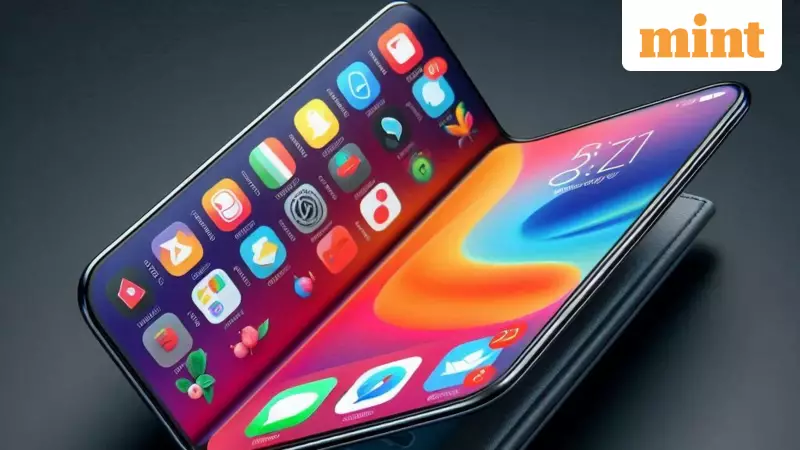
Apple's long-awaited entry into the foldable smartphone arena is back in the news, with a fresh leak suggesting a significant and potentially divisive design choice. The upcoming foldable iPhone might completely eliminate the traditional physical SIM card tray, relying exclusively on embedded SIM (eSIM) technology for cellular connectivity.
The eSIM-Only Controversy and India's Readiness
The latest information originates from Chinese tipster Instant Digital on Weibo, who stated that Apple's first foldable device "will most likely come without a SIM card slot" and support only eSIM. This move aligns with Apple's broader strategy to phase out physical SIMs, a transition already seen in recent iPhone models in the United States.
While eSIM technology is mature in many global markets, the leaker pointed out that this shift could face resistance in China, where adoption lags. For Indian consumers, the change would require an adjustment period. However, the transition is expected to be manageable as major telecom operators like Reliance Jio, Bharti Airtel, and Vodafone Idea (Vi) already provide robust eSIM activation services. Indian users can typically switch to an eSIM digitally, avoiding a visit to a retail store.

Technical Ambitions: A Crease-Free Screen and Powerful Chip
Beyond the connectivity shift, leaks paint a picture of a highly ambitious device. The foldable iPhone, potentially named the iPhone 18 Fold, is rumoured to feature a book-style design akin to Samsung's Galaxy Z Fold series. It is said to sport a compact 5.5-inch outer display and a larger 7.8-inch foldable inner panel.
One of the most compelling claims is that Apple may have engineered a solution to the persistent crease problem common in rival foldables, potentially offering a seamless interior screen without a visible dip. Under the hood, the device is tipped to be powered by Apple's next-generation A20 Pro chip, manufactured using TSMC's advanced 2-nanometer process for major leaps in performance and energy efficiency. Power could come from a new silicon-carbon battery designed to increase capacity without adding bulk.
Design, Camera, and Expected Launch
Early design leaks suggest the foldable iPhone will have a thickness roughly equivalent to two iPhone Air models stacked together, aiming for a sturdy yet pocket-friendly form factor. Apple is also expected to innovate in camera technology, with rumours of a 24-megapixel under-display front camera that promises high-quality selfies without the usual compromises of hidden sensors.
Despite the steady stream of leaks, patience will be required. The debut of Apple's first foldable iPhone is not anticipated until late 2026. If the eSIM-only design is implemented, it would signal Apple's commitment to a port-less future, positioning its inaugural foldable as both a hardware marvel and a pioneer in modern connectivity standards.