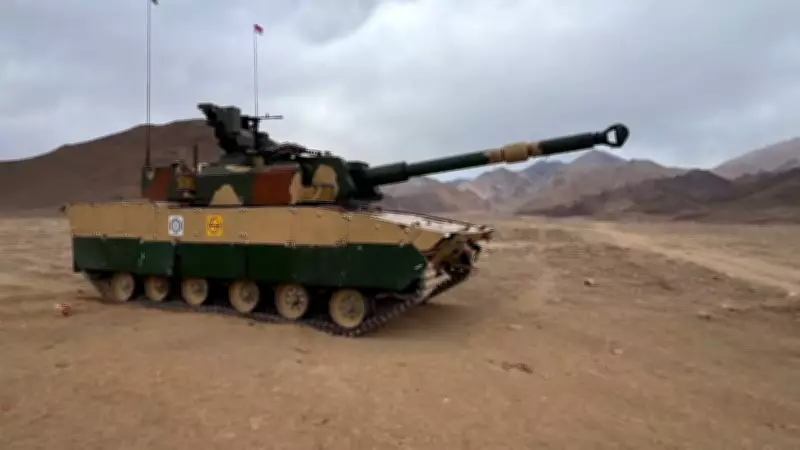
India's defence industry achieved a milestone with the rollout of the Zorawar light tank from the AM Naik Heavy Engineering Complex. Developed in just 19 months, it is the country's first indigenous light tank designed specifically for high-altitude warfare in the Himalayan region.
Conception and Purpose
Zorawar was conceived amid escalating tensions with China along the Line of Actual Control (LAC). It serves as a direct counter to the Type 15 tanks that the Indian Army encountered during the stand-off. Compared to China's Type 15, Zorawar is lighter yet equally well-armed. The tank is named after General Zorawar Singh, a Dogra Army general known as the 'Conqueror of Ladakh'.
Technical Specifications
Weighing approximately 25 tonnes, Zorawar is engineered to operate in extreme terrain and low-oxygen conditions. Its firepower is centered around a Belgian John Cockerill 3105 turret mounting a 105mm rifled gun with an autoloader. This is complemented by a coaxial 7.62mm machine gun, a 12.7mm remote-controlled weapon station, and twin launchers capable of firing Nag Mk2 anti-tank missiles. The integration of the Nag-II ATGM significantly enhances its offensive capability. The army also plans to equip the tank with laser warning receivers and an active protection system.

The tank is powered by a Cummins 760hp diesel engine, with future plans for a 1,000hp upgrade, paired with a Renk transmission. It can reach speeds of up to 70 km/h, has an operational range of 450 km, and features hydropneumatic suspension for traversing rugged terrain. Its relatively light weight allows for deployment via C-17 Globemaster aircraft.
Historical Context
The Indian Army has a history of using light tanks in critical operations. In 1948, Stuart light tanks were used to capture the Zoji La pass. Later, in 1962, AMX-13 tanks were deployed in Chushul, Eastern Ladakh. The AMX-13 also played a crucial role in 1965, blunting Pakistan's Operation Grand Slam in the Chhamb sector.
Induction and Trials
The Indian Army has placed an initial order for 59 units, with a total requirement of 354 tanks, meaning an additional 295 light tanks will be procured through a competitive process. Zorawar is expected to be inducted into service by 2027. The government has cleared a requirement for seven regiments of light tanks. Prototypes have undergone high-altitude trials in Nyoma, Ladakh, at altitudes exceeding 4,200 meters, successfully firing multiple rounds while meeting criteria for firepower, mobility, and protection.
Strategic Impact
Beyond its battlefield capabilities, Zorawar represents a paradigm shift for India's defence industry. It demonstrates the ability to deliver complex, high-technology platforms within compressed timelines, setting a new benchmark. Its modular design integrates indigenous subsystems while selectively partnering with foreign technology, signaling a transition from licensed production to original design and assembly.
The successful development and testing of Zorawar underscore India's growing self-reliance in defence manufacturing and its commitment to safeguarding national interests in challenging high-altitude environments.