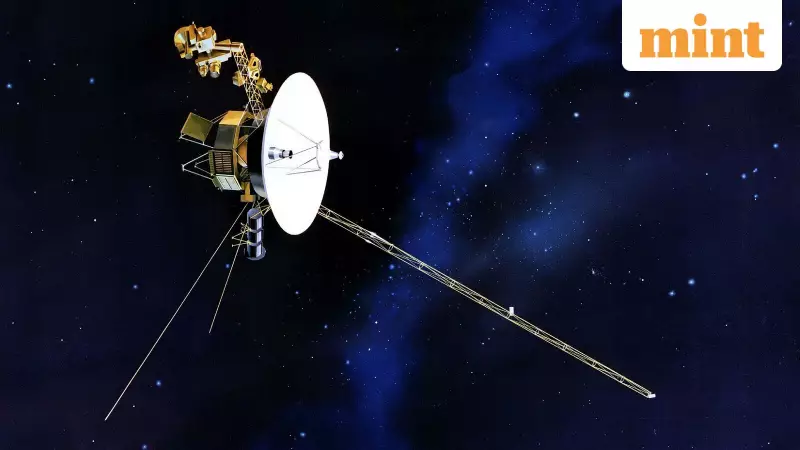
NASA's Voyager 1 Set to Achieve Historic One Light-Day Distance Milestone
NASA's Voyager 1 spacecraft is approaching a historic milestone nearly five decades after its launch. This achievement highlights humanity's longest-running deep-space mission. By November 2026, Voyager 1 is expected to become the first human-made object to reach a distance of one light-day from Earth. That distance is about 16 billion miles away.
Communication Challenges in Deep Space
At that immense range, radio signals traveling at the speed of light will take a full 24 hours to reach the spacecraft. Another 24 hours will pass before a response returns to Earth. Suzy Dodd, Voyager project manager at NASA's Jet Propulsion Laboratory, explained the delay clearly.
"If I send a command and say, 'good morning, Voyager 1,' at 8 a.m. on a Monday, I will receive Voyager 1's response on Wednesday morning at around 8 a.m.," Dodd said.

As Voyager 1 ventures deeper into interstellar space, communication has become increasingly difficult. The spacecraft transmits data at just 160 bits per second. This speed is comparable to early dial-up internet connections.
"The distance from Earth means signals take much longer to arrive, and their strength diminishes along the way," Dodd noted. "It takes multiple antenna arrays to collect that signal."
Because of the limited data rate and extreme distance, engineers receive only small amounts of information about the spacecraft's condition. This limitation makes rapid intervention impossible.
Built for Autonomy and Survival
Despite its age, Voyager 1 was designed with a high degree of autonomy. The spacecraft can handle problems on its own when communication is slow.
"If they get something going wrong, they can put themselves in a safe state so that they can wait until we're able to talk to the spacecraft and figure out what the problem is," Dodd explained.
To extend the mission, NASA has spent years shutting down non-essential instruments and systems. This careful management helps conserve dwindling power supplies.
A Rare and Pioneering Mission
NASA launched Voyager 1 in 1977. The launch occurred during a rare planetary alignment that happens roughly once every 175 years. This unique configuration allowed the spacecraft to use gravitational "slingshot" maneuvers. These maneuvers enabled visits to multiple outer planets, delivering unprecedented scientific results.
The probe flew past Jupiter and Saturn. During these flybys, it discovered new moons, ring systems, and dramatic atmospheric activity. Voyager 1 later headed north out of the ecliptic plane. This move set it on a trajectory out of the solar system.
First into Interstellar Space
In August 2012, Voyager 1 became the first spacecraft to cross the heliopause. This boundary marks where the Sun's influence gives way to interstellar space. The crossing represented a historic moment in space exploration.
As of August 2024, Voyager 1 was about 164.7 astronomical units from Earth. This distance makes it the most distant object ever built by humans. The spacecraft continues to travel at roughly 38,000 miles per hour relative to the Sun.
Four instruments remain operational on Voyager 1. These instruments allow the spacecraft to study cosmic rays, magnetic fields, and plasma waves in interstellar space. The mission continues to provide valuable data from the far reaches of our cosmic neighborhood.