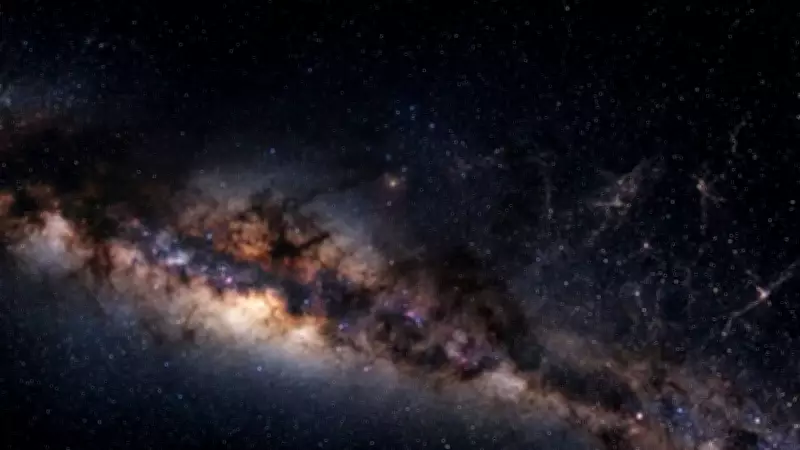
Astronomers from the University of Cape Town (UCT), in collaboration with colleagues from Universite Claude Bernard Lyon 1 (France), Swinburne University of Technology (Australia), and the INAF Osservatorio Astronomico di Cagliari (Italy), have mapped a massive structure in the universe: a huge supercluster partially obscured from view behind the Milky Way's 'Zone of Avoidance.' This region covers about 20 percent of the night sky, containing thick interstellar dust and dense star fields that create an extensive blind spot for optical telescopes.
New Hybrid Mapping Technique Reveals the Vela Supercluster
Using a novel hybrid mapping approach that combines galaxy redshift data with radio wave observations over long distances via the MeerKAT telescope, scientists have discovered the Vela Supercluster. This supercluster spans 300 million light-years and is located 800 million light-years from Earth, filling in a significant missing piece in our understanding of the universe.
Hidden Vela Supercluster Found Behind Milky Way Dust
According to the study published by the University of Cape Town, the discovery of the Vela Supercluster, named 'Vela-Banzi,' serves as a critical piece of evidence related to the explanation of 'cosmic flows'—the large-scale movement of galaxies caused by their mutual gravitational attraction. The presence of significant amounts of dust and gas within the Milky Way's disk had previously obscured the actual distribution of mass in this region. To confirm the supercluster's presence and its effect on the motion of matter in our local universe, scientists employed radio distance measurements to penetrate this obstruction.

Radio Waves Reveal a Cosmic Giant
The term 'Zone of Avoidance' refers to the portion of the sky obscured by our own galaxy's plane. Since its inception, astronomers have been unable to see the entire structure of the local universe within this portion of the sky. By using radio wavelengths instead of optical wavelengths to search for galaxies hidden by the Milky Way, the researchers created a three-dimensional reconstruction demonstrating that the Vela structure is as massive and influential as other well-known structures, such as the Shapley Supercluster.
The Role of Superclusters in Galactic Evolution
To map the 'Cosmic Web'—the large-scale network of filaments and voids that form the universe—it is crucial to understand the Vela Supercluster, as it is one of the nodes in this web. Superclusters pull in surrounding matter and influence how galaxies evolve over billions of years. The addition of this great structure to the map allows astronomers to create a better model of the gravitational forces acting on the Milky Way and other nearby galaxies. This new structure enhances our understanding of the expansion and formation of the local universe and fills a significant gap that has existed since the beginning of extragalactic astronomy.