

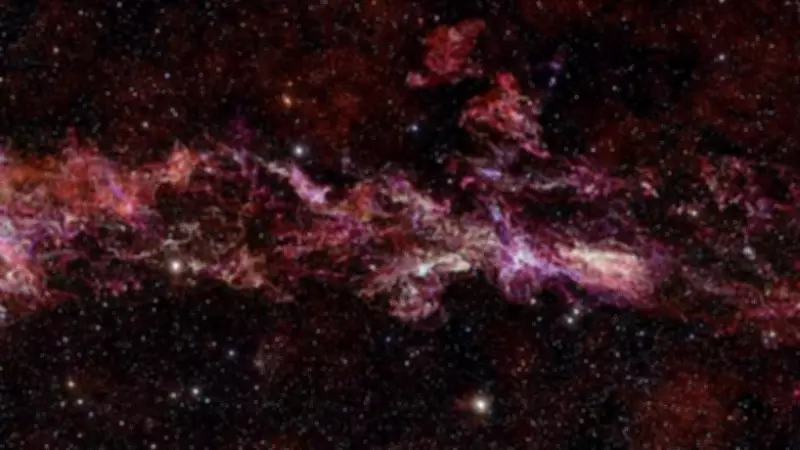
Astronomical Breakthrough: Vast Cold Gas Network Detected at Milky Way's Core
In a groundbreaking discovery, astronomers have successfully observed an extensive web of cold molecular gas situated at the very heart of our Milky Way galaxy. This finding, made possible through advanced telescopic observations, provides unprecedented insights into the complex dynamics and structural composition of galactic centers.
Unveiling the Galactic Center's Hidden Structure
The newly detected cold gas network represents a significant component of the interstellar medium at the galactic core. Unlike the hot, ionized gases typically associated with active galactic nuclei, this cold molecular gas exists at temperatures just above absolute zero, making it crucial for understanding star formation processes.
Key characteristics of the observed gas web include:

- Extensive spatial distribution spanning hundreds of light-years
- Complex filamentary structures resembling a cosmic spiderweb
- Predominantly molecular hydrogen composition with trace elements
- Densities significantly higher than surrounding interstellar regions
Scientific Significance and Research Implications
This discovery challenges previous assumptions about the composition of galactic centers and opens new avenues for astronomical research. The cold gas network appears to play a fundamental role in regulating star formation activity near the supermassive black hole at the Milky Way's center.
"The presence of such extensive cold gas at the galactic center suggests more complex physical processes than previously theorized," explained lead researcher Dr. Anjali Sharma. "This network likely serves as both a reservoir for future star formation and a buffer against the intense radiation from the central black hole."
Observational Techniques and Technological Advances
The detection was made possible through a combination of radio astronomy techniques and infrared observations. Researchers utilized:
- Advanced radio telescopes to detect molecular line emissions
- Infrared arrays to penetrate dust clouds obscuring the galactic center
- Computational modeling to reconstruct three-dimensional gas distribution
- Multi-wavelength observations to confirm temperature and composition
These technological advances allowed scientists to map the gas network with unprecedented resolution, revealing its intricate structure and physical properties.
Future Research Directions and Galactic Understanding
The discovery has significant implications for our understanding of galaxy evolution and star formation processes. Future research will focus on:
- Determining the origin and age of the cold gas network
- Studying its interaction with the central supermassive black hole
- Investigating similar structures in other galaxies for comparative analysis
- Understanding how such gas networks influence galactic-scale phenomena
This observation represents a major step forward in galactic astronomy, providing crucial data that will inform models of galaxy formation and evolution for years to come.






