

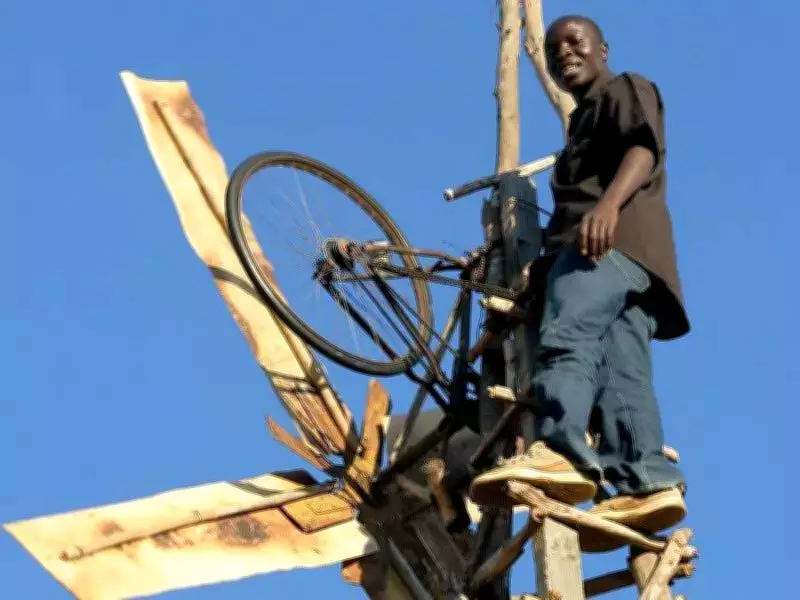
William Kamkwamba: The Teenager Who Harnessed the Wind from Scrap
There is a cinematic quality to the moment William Kamkwamba's story first takes hold. Imagine a 14-year-old boy in rural Malawi, forced to leave school due to poverty, wandering into a modest village library. There, he discovers a book that seems unremarkable at first glance. Inside its pages, he encounters an image of a wind turbine. Though he struggles with the English text, the illustrations speak volumes, unlocking a vision in his mind.
A Famine That Closed One Door and Opened Another
Kamkwamba grew up in Masitala, a farming village in Malawi where his family cultivated maize. In 2001, a severe famine struck after a combination of drought, heavy rains, and the government's sale of the national grain reserve created a devastating food crisis. With his family unable to afford school fees, Kamkwamba dropped out at age 14. This setback is crucial because his windmill was never merely a clever school project. It emerged as a direct response to profound shortages—of money, opportunity, and even light. When formal education denied him access, Kamkwamba turned to self-education, relying on that village library and a borrowed textbook titled Using Energy.
Building Without Blueprints: Improvisation and Ingenuity
What Kamkwamba constructed was raw and unpolished, born of necessity rather than perfection. Using the book's drawings as a rough guide, he improvised the rest, assembling a 16-foot windmill from whatever materials he could scavenge. Historical accounts, including those from Britannica, note his use of tractor parts, bicycle components, plastic pipes, and tree branches. According to TED, this makeshift creation powered four lights and two radios in his family home. Soon, neighbors began arriving to charge their mobile phones.

The scene is undeniably compelling, but the true narrative is less about miraculous luck and more about relentless method. Kamkwamba tested, adjusted, failed, and tried again, persisting until the machine finally held together. In a world that often equates innovation with well-funded laboratories and institutional support, his windmill stands as a testament to the power of persistence driven by sheer necessity.
From Local Curiosity to Global Inspiration
Initially, Kamkwamba's achievement was known only locally, but it quickly gained national attention in Malawi after being featured in a local newspaper. The story then spread rapidly online, eventually capturing the interest of TED. He was invited to TEDGlobal on a fellowship, where he shared his invention and expressed his aspirations to build a larger windmill for irrigation and to resume his education.
This next phase is pivotal: the windmill did not conclude his journey; it launched it. Kamkwamba returned to school, studied at the African Leadership Academy in South Africa, and later graduated from Dartmouth College in 2014 with a degree in environmental studies. The machine crafted from scrap metal became a literal bridge back to formal education.
Expanding Impact: From One Home to an Entire Community
Kamkwamba did not stop at a single invention. He proceeded to construct additional windmills to generate electricity and pump water for his village. In 2008, he co-founded the Moving Windmills Project, which collaborates with residents of the Masitala area on initiatives like clean-water wells, solar panels for schools and community centers, and practical solutions for everyday farming challenges.
This marks where his story evolves from personal inspiration to tangible infrastructure. The goal was never solely to illuminate his own home. It was to envision how light, water, and dignity could become more reliable for others as well. Herein lies the quiet strength of his tale: invention as an act of service, not mere performance.
The Enduring Legacy: What Kamkwamba's Story Asks of Us
It would be simplistic to reduce William Kamkwamba to a motivational cliché—a poor boy with a big dream and a happy ending. Such a portrayal overlooks the harder truths. His accomplishment arose because a curious intellect confronted a brutally practical problem, and because he continued learning after the system had essentially written him off.

The windmill matters not because it was glamorous, but because it was profoundly useful. It provided light, certainly, but it also restored a sense of agency. That is why this narrative endures. In Kamkwamba's hands, discarded scrap transformed into a shelter against hopelessness. His example delivers an urgent, unfashionably simple message: progress often begins when someone decides that the materials lying around are sufficient to start building a better future.





