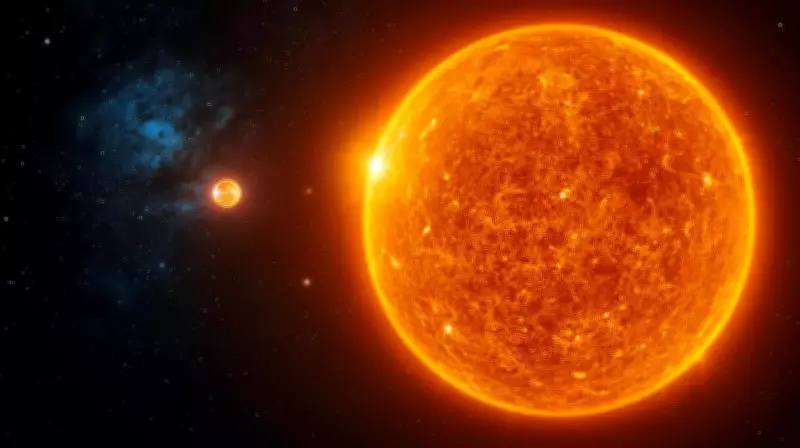
Giant Star WOH G64 Undergoes Rapid Transformation in Nearby Galaxy
Far beyond our own Milky Way galaxy, in the neighboring Large Magellanic Cloud, a colossal star named WOH G64 has been exhibiting unexpected behavior that has captivated astronomers worldwide. Located approximately 163,000 light-years from Earth, this stellar giant measures about 1,540 times the diameter of our Sun and boasts a mass nearly 30 times greater. For decades, scientists classified WOH G64 as a red supergiant, a late evolutionary stage for massive stars typically culminating in a supernova explosion. However, recent observations reveal that this star is no longer conforming to standard red supergiant characteristics, presenting a fascinating cosmic puzzle.
From Red Supergiant to Yellow Hypergiant: A Swift Cosmic Shift
Since the 1970s, WOH G64 has been recognized as one of the most extreme red supergiants known, characterized by its cool temperature, immense luminosity, and dense dust envelope. Red supergiants are aging massive stars that have expanded and cooled after exhausting much of their core nuclear fuel. These stars are inherently unstable but usually evolve slowly over millennia. This makes the recent changes in WOH G64 particularly striking.
Around 2014, astronomers noticed significant alterations in the light emitted by WOH G64. The star's spectrum began shifting toward bluer and hotter wavelengths, with traditional red supergiant features diminishing and warmer signatures emerging. This led researchers to conclude that WOH G64 has likely transitioned into a yellow hypergiant, a rare and brief phase in the evolution of very massive stars. Yellow hypergiants are hotter than red supergiants and exhibit extreme instability, often ejecting vast amounts of material into space. While this transformation appeared gradual in human terms, it was remarkably abrupt by cosmic standards, occurring over just a few years rather than the expected centuries or millennia.

Potential Explanations for the Stellar Metamorphosis
Scientists have proposed two primary theories to explain this rapid change. The first hypothesis suggests that WOH G64 experienced a massive eruption, shedding its outer layers and exposing hotter interior regions, thereby increasing its surface temperature. The second theory involves binary interaction, as evidence indicates WOH G64 might be part of a massive symbiotic binary system. In this scenario, gravitational interactions with a companion star could have triggered material loss or atmospheric disturbances, facilitating the transformation. Both explanations emphasize significant mass loss, a key process influencing the ultimate fate of massive stars.
Uncertain Future and Ongoing Astronomical Observations
The future trajectory of WOH G64 remains uncertain. It may continue in an unstable state for an extended period before potentially collapsing into a supernova. Alternatively, some massive stars can collapse directly into black holes without a visible explosion. Astronomers are closely monitoring WOH G64, as it offers a rare opportunity to observe stellar evolution in near real-time. This case underscores that even well-studied celestial objects can still surprise us, revealing new insights into the dynamic processes shaping our universe.