

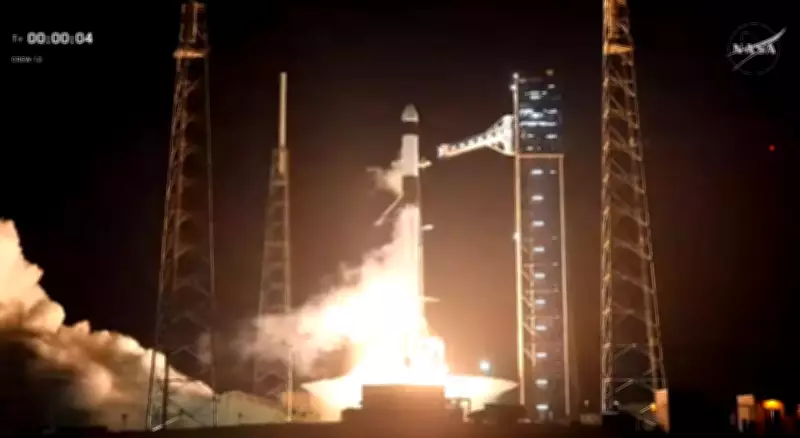
SpaceX Crew-12 Mission Successfully Launches Four Astronauts to ISS
As dawn broke over the Florida coastline, a Falcon 9 rocket illuminated the morning sky with its powerful ascent from Space Launch Complex 40. At precisely 5:15 a.m. EST (3:45 p.m. IST), the spacecraft carrying NASA's SpaceX Crew-12 mission lifted off from Cape Canaveral Space Force Station, marking the beginning of a significant journey to the International Space Station.
Historic Launch and Crew Composition
The climb was steady and brilliant against the pale morning sky. Inside the Dragon spacecraft, an international crew of four experienced astronauts prepared for their mission: NASA astronauts Jessica Meir and Jack Hathaway, European Space Agency astronaut Sophie Adenot, and Roscosmos cosmonaut Andrey Fedyaev. Within minutes of launch, they experienced forces of approximately 2 g as the vehicle accelerated through Earth's lower atmosphere.
This flight represents the twelfth crew rotation mission under NASA's Commercial Crew Program, continuing the agency's commitment to regular transportation services to the orbiting laboratory. The program has revolutionized access to space through public-private partnerships with companies like SpaceX.

Critical Flight Milestones Achieved
Several minutes into the flight, the rocket passed through max q—the point of maximum mechanical stress on the vehicle. Shortly afterward, the nine Merlin engines on the first stage shut down as planned, followed by stage separation. The booster then began its controlled descent back toward Cape Canaveral.
In a notable first for the launch site, the booster returned and landed successfully within the Space Launch Complex 40 perimeter. SpaceX recently confirmed that Landing Zone 40 will serve as the primary return location for such missions moving forward. The successful landing prompted a brief cheer in mission control before attention returned to the orbital phase of the mission.
Orbital Operations Begin
At 5:24 a.m. EST (3:54 p.m. IST), Dragon separated from the second stage and began flying independently at approximately 17,500 miles per hour. The nosecone opening sequence followed shortly after, allowing the spacecraft to settle into its planned orbit around Earth.
The crew will now spend approximately 34 hours making gradual orbital adjustments before docking with the International Space Station's Harmony module. Docking is scheduled for around 3:15 p.m. EST on Saturday (1:45 a.m. IST on Sunday).
Mission Timeline and Scientific Objectives
During the early orbital phase, the astronauts will remove their helmets and transition from their launch positions. Systems checks will continue as Dragon travels around Earth at nearly 17,000 miles per hour.
A post-launch news conference is scheduled for 6:45 a.m. EST (5:15 p.m. IST) from NASA's Kennedy Space Center, with officials from NASA, ESA, and SpaceX expected to provide updates and answer questions about the mission.
Crew-12 will spend more than six months aboard the International Space Station conducting vital scientific research. Their work will include medical studies, plant growth experiments, and technology testing specifically aimed at supporting future missions to the Moon and Mars. These investigations are crucial for advancing human space exploration capabilities and understanding long-duration spaceflight effects.
For now, the Dragon spacecraft continues its quiet journey through space, gradually closing the distance to the International Space Station as it orbits our planet.






