

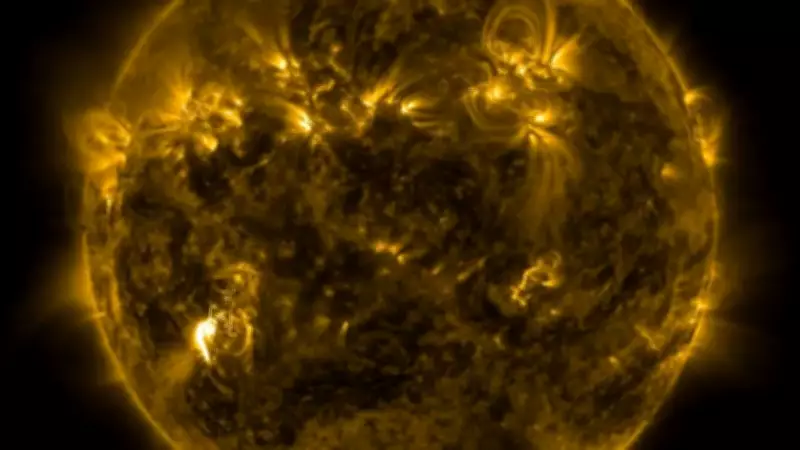
Solar Flare Erupts, Briefly Disrupts Communications Across Asia and Australia
A significant burst of solar activity captured global attention this week, occurring just days before one of the most anticipated space missions in recent history. The Sun unleashed an X1.4-class solar flare, a powerful event strong enough to temporarily disrupt radio signals across parts of Asia and Australia, raising concerns about potential risks to astronauts and space operations.
NASA's Solar Dynamics Observatory Captures the Event
The flare erupted late at 11:19 pm EDT on March 29, quickly classified as an X-class event, which represents the most intense category used by scientists to measure solar storms. These flares can release substantial amounts of radiation and energy, often capable of interfering with satellites or communication systems on Earth. In this instance, a short-lived radio blackout was reported in regions of Asia and Australia, aligning with expert expectations for a flare of this magnitude, as documented by Space.com.
Coronal Mass Ejection Accompanies the Flare
Alongside the flare, the Sun also emitted a coronal mass ejection (CME), a cloud of charged particles ejected into space. When directed towards Earth, such ejections can interact with the planet's magnetic field, potentially triggering geomagnetic storms that might affect satellites or power grids. However, experts emphasize that timing is a critical factor in assessing impacts.

NASA Assures No Impact on Artemis II Launch
Officials at Kennedy Space Center addressed the situation with calm and precision. Amit Kshatriya, speaking during a press briefing, stated that the CME associated with the flare is not expected to create any meaningful impact on the upcoming Artemis II mission. He clarified that the team is not tracking any concerns that would necessitate delaying or canceling the launch.
NASA experts further confirmed that the mission management team has reviewed the latest space weather data and decided to proceed as planned. The launch remains scheduled for 6:24 p.m. EDT on April 1, 2026, with forecasts indicating favorable weather conditions at the launch site.
Radiation Shelter Protocol for Astronaut Safety
Despite the reassuring updates, space agencies maintain a vigilant stance towards solar activity. Radiation exposure poses a significant risk for astronauts traveling beyond Earth's protective magnetic shield, particularly on missions to the Moon where this natural defense is reduced.
To mitigate this risk, Artemis II incorporates a built-in safety test. The astronauts will practice setting up a radiation shelter inside their spacecraft, a designated area designed to provide additional shielding in case of unexpected increases in radiation levels.
This proactive measure underscores NASA's commitment to ensuring crew safety amidst the dynamic conditions of space exploration.






