

Skyroot Aerospace Prepares for Historic Vikram-1 Orbital Launch
Hyderabad-based Skyroot Aerospace is advancing towards the launch of Vikram-1, India's first privately developed orbital rocket. This milestone positions the startup as a key contender in the specialized launch segment, with ambitions to democratize space access. Co-founder Pawan Kumar Chandana draws an analogy to illustrate the company's strategy: "Think of SpaceX as a transcontinental train or an A380. We're aiming to become the cab or business jet that drops you at a specific slot in a unique orbit in space with our smaller rockets." This vision underscores Skyroot's focus on bespoke, door-to-door missions that larger spacetech giants often overlook.
Building on Past Success and Niche Market Focus
The company's journey began with the successful sub-orbital launch of Vikram-S in November 2022, a feat achieved on the first attempt—something even SpaceX did not accomplish initially. This success has bolstered Skyroot's credentials as it carves out a niche in the space industry. Chandana emphasizes that the goal is not to compete with giants but to serve a dedicated market with unique requirements. "The market for train is different and that for cab is different. We want to address a different niche where people have unique needs," he explains, highlighting the company's tailored approach to satellite launches.
Vikram-1: Technical Details and Launch Preparations
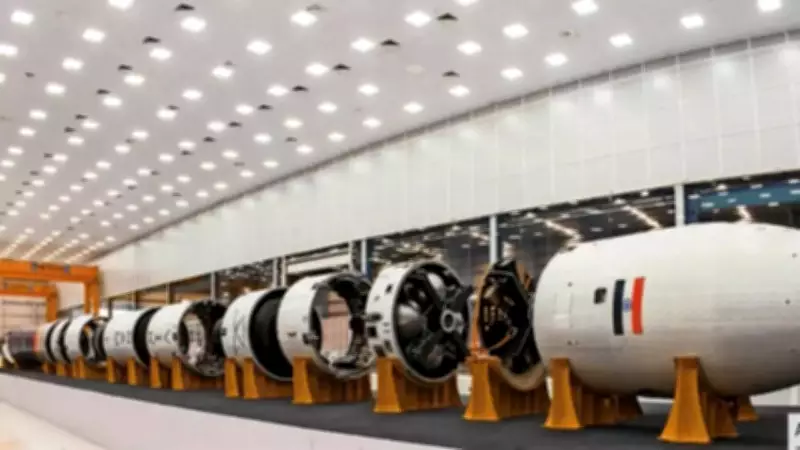
Vikram-1, named after Vikram Sarabhai, the father of India's space program, is a seven-storeyed rocket standing 75 feet tall with a payload capacity of approximately 300kg. However, the initial orbital mission may carry only half that weight. The rocket features an all-carbon composite structure, solid fuel boosters, and a 3D-printed liquid engine called Raman-2. Currently, assembly is underway at Skyroot's headquarters, Max-Q, located near Shamshabad International Airport in Hyderabad.

Chandana reveals that the three solid propellant stages—Kalam-1200, Kalam-250, and Kalam-125—are already at the launch site in Sriharikota, Andhra Pradesh. The remaining sections, including the orbit adjustment module and avionics, are undergoing final integration checks in Hyderabad before being transported via specially fitted trucks. "Hopefully, within weeks, we can move them to the launch site," he says, though the exact launch slot will be announced once formally assigned.
Funding, Infrastructure, and Strategic Partnerships
As a space startup, Skyroot operates with tighter budgets and resources compared to national programs. The company has raised nearly $100 million in funding and is poised to become India's first spacetech unicorn in its next funding round. To enhance production capabilities, Skyroot established the Infinity Campus last year, enabling the assembly of one Vikram-class rocket per month. "Hopefully, we want to reach that cadence next year," Chandana notes.
While Vikram-1 will launch from ISRO's Satish Dhawan Space Centre, future missions may utilize the private launch pad at Kulasekarapattinam, expected to be operational by March-end. Skyroot has also forged strategic partnerships through MoUs with entities like French newspace operator Promethee and German satellite aggregator Exolaunch, as well as Indian startups Dhruva Space and Bellatrix Aerospace, to deploy satellites on Vikram-1.
Challenges and Long-Term Aspirations
Despite initial targets for a 2024 launch, testing and system integration have extended timelines, with a current aim for Q1 2026. Nevertheless, Skyroot remains committed to its motto, 'Opening Space for All.' The ultimate goal is to make human space travel as affordable as air travel by developing reusable rockets. "In future, we will build reusable rockets that will be much bigger. That is our aspiration before the end of the decade," Chandana asserts, indicating that plans are already on the drawing board.
With competitors like Agnikul Cosmos also preparing for orbital launches, India's private space sector is poised for significant growth. Skyroot's focus on affordability, accessibility, and innovative technology positions it as a trailblazer in this emerging field.






