Hyderabad-Led Research Team Unveils Eco-Friendly Silver Nanoparticles with Dual Applications
A collaborative research team from Hyderabad, Bangkok, Chennai, and Warangal has achieved a significant breakthrough by developing silver nanoparticles through a room-temperature, environmentally friendly synthesis method. According to a study published in the journal Scientific Reports, these nanoparticles demonstrate remarkable capabilities in both degrading industrial dyes under visible light and functioning as a conductive ink for printed electronic circuits.
Innovative Room-Temperature Synthesis Method
The study, titled "Metal-Displacement-Derived Silver Nanoparticles for Visible-Light Catalysis and TENG-Enabled Circuit Integration," was spearheaded by Chenna Reddy Mallu from the Department of Chemistry at Geethanjali College of Engineering and Technology in Hyderabad. The research team included Manikandan Dhayalan of Chulalongkorn University in Bangkok, Govindhasamy Murugadoss from Sathyabama Institute of Science and Technology in Chennai, and Khanapuram Uday Kumar of the National Institute of Technology in Warangal.
One of the primary challenges in silver nanoparticle research has been devising a method that is rapid, scalable, and environmentally sustainable while producing stable particles suitable for diverse applications. To overcome this, the team introduced a synthesis route based on a metal-displacement process that generates uniformly dispersed, oxidation-resistant silver nanoparticles at ambient room temperature.

In this innovative approach, magnesium served as a sacrificial reductant, with tartaric acid acting as both a reducing agent and a capping agent. This magnesium–tartrate dual-agent strategy facilitated rapid nucleation and growth at room temperature without employing harsh chemicals. The process successfully yielded silver nanoparticles within the size range of 25 to 50 nanometers.
Structural, optical, and surface analyses confirmed the formation of pure metallic Ag⁰ nanoparticles. The researchers attributed the stability of these particles to tartrate chelation, ensuring their robustness for practical applications.
Effective Degradation of Industrial Dyes
The synthesized silver nanoparticles exhibited potent photocatalytic activity against two industrial dyes when exposed to visible light. The study reported an impressive 91.6% degradation of Acid Yellow and 89.4% degradation of Rose Bengal within a span of 180 minutes. This degradation followed first-order kinetics, indicating efficient and consistent performance.
These findings suggest that the material holds substantial potential for treating dye-polluted wastewater. The research positions this application within the broader context of environmental remediation, highlighting that the nanoparticles can operate effectively under visible light while being produced through a room-temperature process, enhancing their sustainability profile.
Conductive Ink for Printed Electronics and Self-Powered LEDs
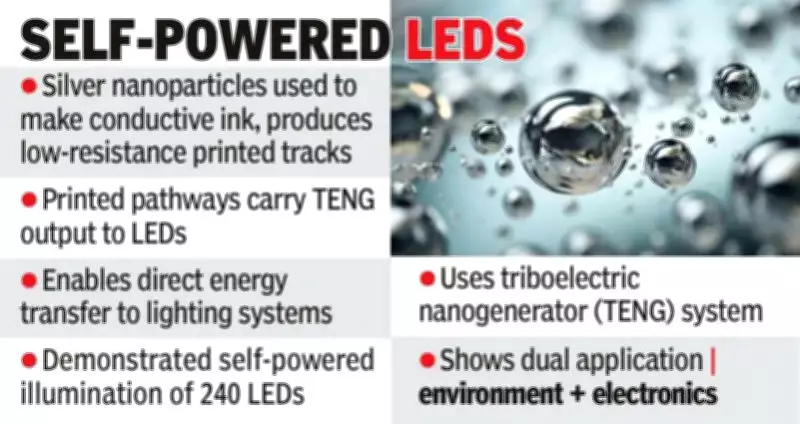
Beyond their environmental applications, the researchers formulated the silver nanoparticles into a conductive ink capable of producing low-resistance printed tracks. These printed pathways were then utilized to deliver the output of a triboelectric nanogenerator (TENG) directly to light-emitting diodes (LEDs).
Using the Ag-ink-printed tracks, the team demonstrated the self-powered illumination of 240 LEDs. This achievement underscores that the same nanoparticle system can be leveraged not only for environmental cleanup but also for advancing next-generation printed electronics, showcasing its versatility and multifunctional nature.
The development represents a significant step forward in nanotechnology, merging eco-friendly synthesis with dual-purpose functionality that addresses both environmental challenges and technological advancements in electronics.