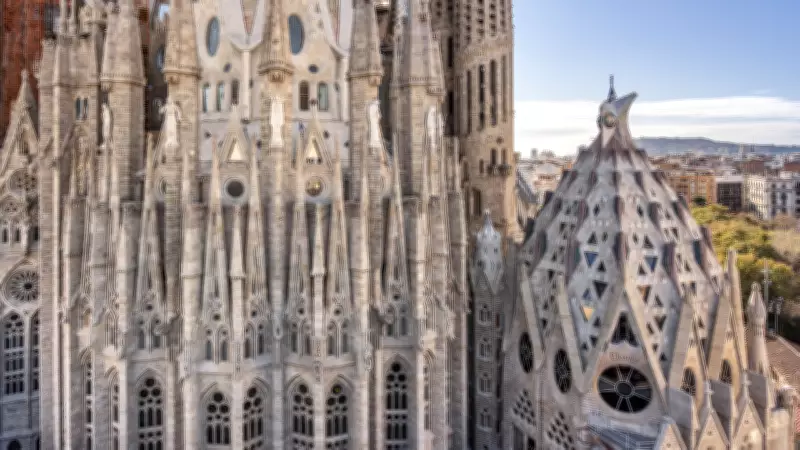
More than 140 years after the first stone was laid, Barcelona's Sagrada Família continues to rise. Construction began in 1882, yet cranes still surround the basilica today as engineers work towards completing one of the most ambitious religious structures ever attempted. Designed by Antoni Gaudí, the church is expected to become the world's tallest church upon completion, with the central Tower of Jesus Christ reaching 172.5 metres (566 feet). What makes the project remarkable is that many of its core engineering concepts were developed before modern computers, reinforced concrete skyscrapers, or digital modelling existed. Gaudí relied on geometry, gravity, and observations from nature to solve structural problems that continue to fascinate architects and engineers. The result is a building where nineteenth-century design principles and twenty-first-century technology meet on an unprecedented scale.
How Antoni Gaudí used nature-inspired engineering to design Sagrada Família
When Antoni Gaudí, also known as “God's own architect,” took over the project in 1883, he abandoned conventional Gothic design methods and began developing a structural system inspired by the natural world. Instead of relying on traditional flying buttresses, Gaudí designed inclined columns that branch like trees. These columns distribute weight through multiple load paths, reducing stress concentrations within the structure. According to the Sagrada Família Construction Board, the architect used hanging-chain models to calculate the most efficient shapes for arches and vaults. By suspending strings weighted with small bags and then photographing the inverted model, Gaudí could identify naturally stable structural forms. The basilica's famous interior reflects this approach. Columns divide and spread towards the ceiling like tree branches, allowing loads to be transferred efficiently while creating an open interior space filled with natural light. As the official Sagrada Família documentation explains, Gaudí sought "the equilibrium of forces found in nature," using geometry rather than excessive material mass to achieve stability.
Why the 172.5-metre towers are transforming church engineering
The central Tower of Jesus Christ is designed to reach 172.5 metres, making Sagrada Família the tallest church building in the world upon completion. Gaudí intentionally chose this height because he believed no human-made structure should exceed the height of Montjuïc, the hill overlooking Barcelona. The tower will therefore stop just short of the natural elevation of the landscape. Constructing a tower of this scale presents significant engineering challenges. Wind loading, vibration control, weight distribution, and long-term material durability all require precise modelling. Engineers have integrated reinforced stone, steel elements, and advanced construction techniques while preserving the appearance of Gaudí's original vision. Research published by the Sagrada Família Technical Office highlights how digital simulations are used to evaluate structural behaviour under various environmental conditions before construction proceeds. Unlike medieval cathedrals, which often relied on trial and error over centuries, modern engineers can test thousands of structural scenarios before a single component is installed.


The modern technology completing a nineteenth-century vision
Perhaps the most unusual aspect of Sagrada Família is that its construction spans three different technological eras. Gaudí worked with hand-drawn plans and physical models. Twentieth-century architects relied on photographs, surviving sketches, and manual calculations after many original plans were destroyed during the Spanish Civil War. Today's engineers use advanced computational design, 3D modelling, and digital fabrication technologies. According to researcher Mark Burry, digital modelling has allowed engineers to reconstruct complex geometries that would have been extremely difficult to calculate manually. In his book Scripting Cultures: Architectural Design and Programming, Burry explains that computer-aided manufacturing techniques now help produce intricate stone and structural components with millimetre-level precision. Despite these technological advances, the project remains rooted in Gaudí's original geometric principles. Hyperboloids, helicoids, and ruled surfaces continue to define much of the structure's appearance and stability. The basilica therefore represents something rarely seen in architectural history: a building designed in the nineteenth century but completed using twenty-first-century engineering tools.
Why Sagrada Família remains one of the world's greatest engineering experiments
Few structures have remained under construction for so long while retaining a clear architectural identity. Sagrada Família is not simply a church or a tourist landmark. It is a live demonstration of how engineering knowledge evolves across generations. Master stonemasons, structural engineers, computer scientists, architects, and craftspeople have all contributed to the same project across more than a century. What visitors see today is the product of both historical ingenuity and modern innovation. Gaudí's gravity models have been translated into computer simulations. Hand-carved stonework now works alongside digitally fabricated components. Ideas first sketched in the nineteenth century are being realised with technologies their creator could never have imagined. More than a century after construction began, Sagrada Família continues to demonstrate that great engineering projects are not always measured in years or decades. Sometimes they are measured in generations.