Pune Scientists Unlock Secret of Universe's Largest Spiral Galaxy
Scientists in Pune have finally solved a cosmic mystery that puzzled astronomers for four decades. Researchers at the Inter-University Centre for Astronomy and Astrophysics (IUCAA) discovered how Malin 1, the largest spiral galaxy ever found, continues to grow in size. Their findings reveal a gentle process unlike anything seen before in giant galaxies.
Silent Cannibalism Instead of Violent Collisions
Most giant galaxies grow through violent mergers with other large galaxies. These collisions typically disrupt their delicate structures. Malin 1 follows a different path. The Pune team found it gradually absorbs much smaller dwarf galaxies instead. This quiet process allows the galaxy to expand without damaging its thin, faint spiral shape.
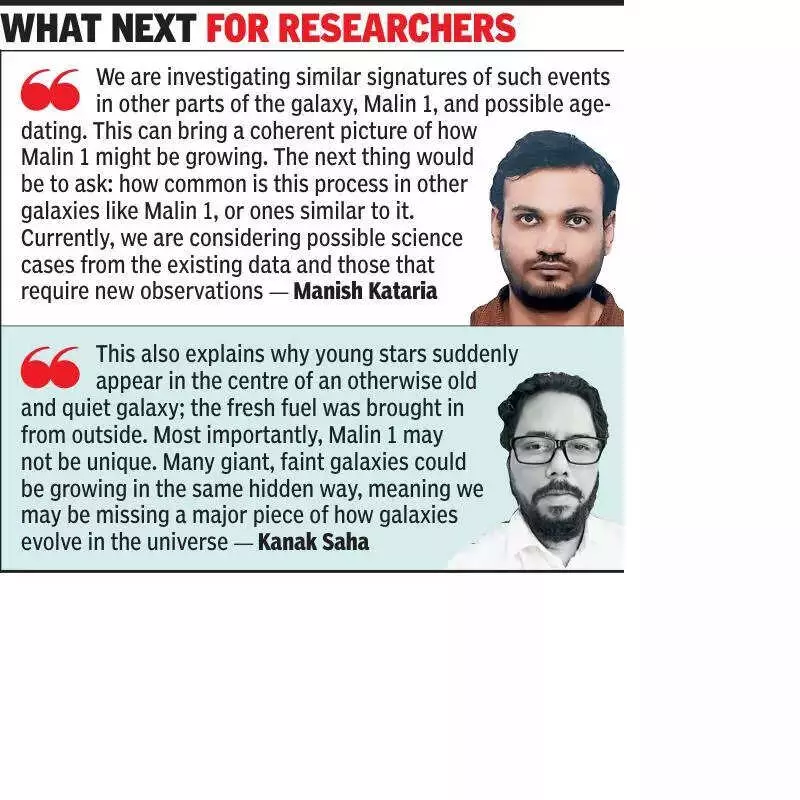
"If the Milky Way is a well-lit small town, Malin 1 would be a vast, dimly lit megacity seen from afar," said Manish Kataria, who led the research team with Kanak Saha. He emphasized how different these two galaxies truly are.

Advanced Instruments Reveal Hidden Truth
The scientists used India's AstroSat satellite and the MUSE instrument on the Very Large Telescope to peer into Malin 1's heart. They discovered something remarkable. Young stars, aged between 200 million and 500 million years, mixed with ancient stars about 6 billion years old. This unusual combination quietly transforms the galaxy's central region.
Malin 1 presents extraordinary characteristics. It remains extremely faint yet massively large. Its central region alone matches the entire stellar disk of our Milky Way in size. For forty years since its discovery, astronomers struggled to understand how such a structure could exist.
Defying Galactic Physics
"To build such a huge disk of stars and gas, a galaxy must retain high angular momentum," explained Kataria. "In the early universe, galaxies typically lose angular momentum through mergers and interactions. Malin 1 somehow kept its high angular momentum."
This behavior violates typical galactic development patterns. Normally, a disk this large would fragment into pieces. The Pune researchers needed to explain this anomaly.
The Gentle Merger Process
Galaxy mergers happen commonly across the universe. Our Milky Way will eventually merge with Andromeda. Malin 1 undergoes mergers too, but in an unusually gentle manner.
"Identifying past minor mergers is much like doing archaeology," said Kataria. "It's possible for nearby galaxies like the Milky Way and Andromeda, but Malin 1 lies over 1.2 billion light-years away. This makes the task extremely challenging."
The team believes a small dwarf galaxy fell into Malin 1's central region on a polar orbit. This specific trajectory allowed absorption into the core without disturbing the fragile outer disk. The orbit also brought pristine, metal-poor gas that fueled new star formation.
The Crucial Clump Discovery
Scientists spotted a strange clump in Malin 1's core, which they named C1. This discovery proved crucial to their breakthrough. Clump C1 appeared brightest in far-UV images taken by UVIT on AstroSat. It hosted young stars in an otherwise largely dormant galaxy.
"Normally, material in a galaxy moves roughly with the local rotational speed," explained Saha. "But C1 moved about 150 km/s faster than its surroundings. This distinct velocity indicates the clump's bulk material is kinematically decoupled from the rest of the galaxy, suggesting an external origin."
Surprising Chemical Composition
Existing predictions suggested Malin 1 should form metal-rich stars similar to our sun if it used its own gas. The researchers expected to see such stars in C1. Instead, they found young stars that were metal-poor and alpha-enriched with elements like oxygen, magnesium, and silicon.
This chemical signature strongly indicates the gas came from outside Malin 1. It likely originated from a small, metal-poor dwarf galaxy that merged gently with the giant spiral. The findings were published in the Astrophysical Journal Letters in December 2025.
The Pune team's work not only solves a long-standing cosmic mystery but also reveals a new pathway for galactic evolution. Their discovery shows giant galaxies can grow through quiet, gentle processes that preserve their delicate structures across billions of years.