

Pune Scientists Develop Breakthrough Method to Correct Galaxy Distance Errors
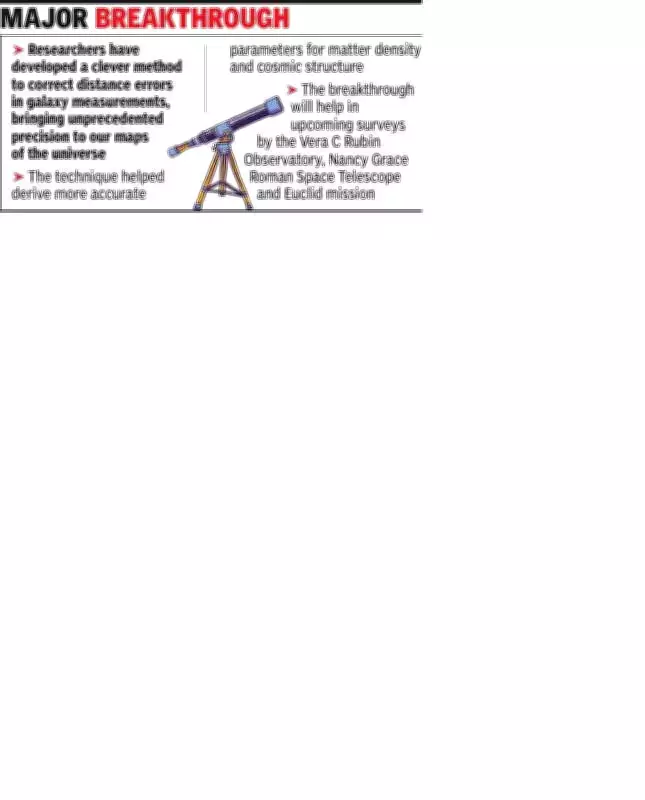
Researchers from Pune have devised an innovative technique to correct distance errors in galaxy measurements, significantly enhancing the accuracy of our cosmic maps and advancing our understanding of dark matter and the evolution of the universe. This breakthrough promises to revolutionize astronomical surveys and cosmological studies.
Revolutionizing Cosmic Measurements
Divya Rana of Leiden University and Surhud More of the Inter-University Centre for Astronomy and Astrophysics (IUCAA) in Pune recently published their groundbreaking findings in Physical Review. Their research presents a method that will dramatically improve distance measurements for galaxies across the cosmos, addressing a critical challenge in modern astronomy.
The technique focuses on ensuring highly accurate redshift measurements, which are essential for reliable studies of dark energy and the universe's evolution. This advancement comes at a crucial time as major astronomical projects prepare to launch, including surveys by the Vera C Rubin Observatory, the Nancy Grace Roman Space Telescope, and the Euclid Mission.

Understanding Weak Gravitational Lensing
Astronomers rely on the faint light from distant galaxies to unravel the history and composition of our universe. As this light travels toward Earth, it passes by closer foreground galaxies. The gravity of these foreground galaxies bends and distorts the light—a phenomenon known as weak gravitational lensing.
These distortions enable scientists to map matter, most of which is invisible dark matter, and study how cosmic structures form over time. However, to accurately interpret these observations, researchers must precisely determine how much the light has stretched during its journey, a concept called redshift. Uncertainty in redshift measurements can lead to biased understanding of the cosmological parameters that describe the universe.
The Cosmic Ruler Approach
"We started our work in 2023," explained Surhud More. "By comparing how matter around the same foreground galaxies bends light from background galaxies at different distances, we can cancel out complex astrophysical effects and isolate a clean measurement of the universe's geometry."
More described their method as using a cosmic ruler to correct distance estimates. "The most challenging part was running a large number of tests to ensure our results were robust," he added, highlighting the rigorous validation process behind their discovery.
Successful Application and Results
The researchers applied their innovative approach to data from the Subaru Hyper Suprime-Cam (HSC) survey, a massive project mapping the distribution of matter across the sky. Their technique successfully corrected biases in redshift estimates, leading to more reliable cosmological parameters.
These improved parameters include the density of matter in the universe and the amplitude of inhomogeneities, which measure variations between dense and less-dense regions. This correction represents a significant step forward in cosmological research, providing scientists with more accurate tools to study the fundamental properties of our universe.
Implications for Future Research
This breakthrough has far-reaching implications for the field of astronomy and cosmology. By providing more accurate distance measurements, the technique will enhance the quality of data from upcoming astronomical surveys, enabling more precise studies of dark energy, dark matter, and cosmic evolution.
The research demonstrates how innovative approaches can overcome longstanding challenges in scientific measurement, paving the way for new discoveries about the nature and history of our universe. As astronomical technology advances, methods like this will be crucial for interpreting the vast amounts of data collected by next-generation observatories.






