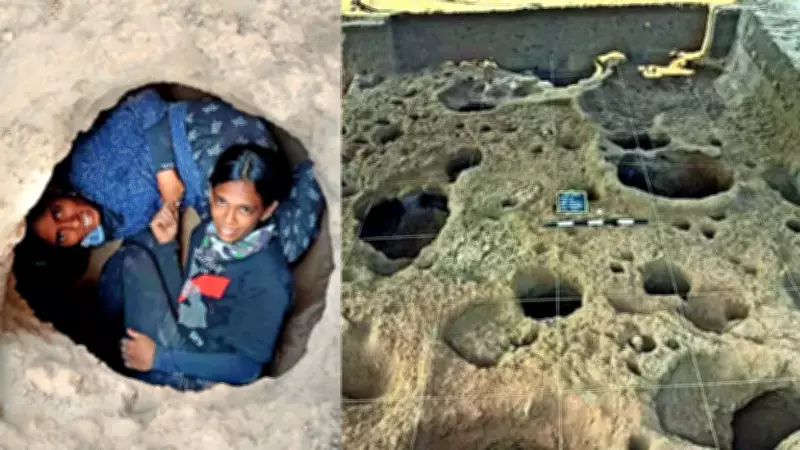
Archaeologists from Tamil University have unearthed rare 'pit houses' dating to the Neolithic period at Molapalayam near Coimbatore, on the foothills of the Western Ghats. The agro-pastoral community that lived here around 3,500 years ago likely used the pits within their houses to store foodgrain or protect themselves from natural disasters, according to researchers.
Evidence of domestic activities
Some pits contained querns or grinding stones, suggesting they may have been used as kitchens. The pits, large enough to hold one or two people, also revealed skeletal remains of two infants, confirming that ancient people buried their dead near their dwellings. Archaeologist V Selvakumar from Tamil University's department of maritime archaeology noted that a similar Neolithic site in Paiyyampalli, Tirupattur district, excavated in the 1960s, had comparable pit houses.
Lifestyle and diet
Analysis of bone and plant remains indicates that the Neolithic inhabitants reared cattle, sheep, and goats, and cultivated millets and pulses. Cut marks on bones suggest they hunted animals for meat. Artefacts such as shell pendants point to contact with coastal communities. The site yielded numerous ancient grinding stones, likely used for grinding grains and seeds, along with an earthen lamp and a variety of pottery, including burnished ceramics, red ware, black ware, black-and-red ware, and coarse red ware. Stone tools such as hand axes, hammer stones, arrowheads, microliths, and bone tools were also discovered.

Seasonal habitation
Researchers believe the ancient people lived at the site during the high rainfall season from June to December, moving near the Siruvani river during the drier months from January to May. Archaeobotanist Sathish Naik from Deccan College examined plant remains and identified several millet species, including kodo millet (varagu), little millet (samai), proso millet (panivaragu), browntop millet (kulasamai), foxtail millet (tinai), and barnyard millet (kuthiraivali).
Faunal diversity
Analysis of bone remains by G S Abhayan of Kerala University revealed the presence of cattle, buffalo, goat, sheep, pig, dog, nilgai, blackbuck, gazelle, chital, leopard, and wild cat. Cut marks on bones indicate that these animals were hunted for meat. Recently, researchers also found bone remains of the Indian rhino, suggesting that this herbivore once roamed the foothills of the Western Ghats.