

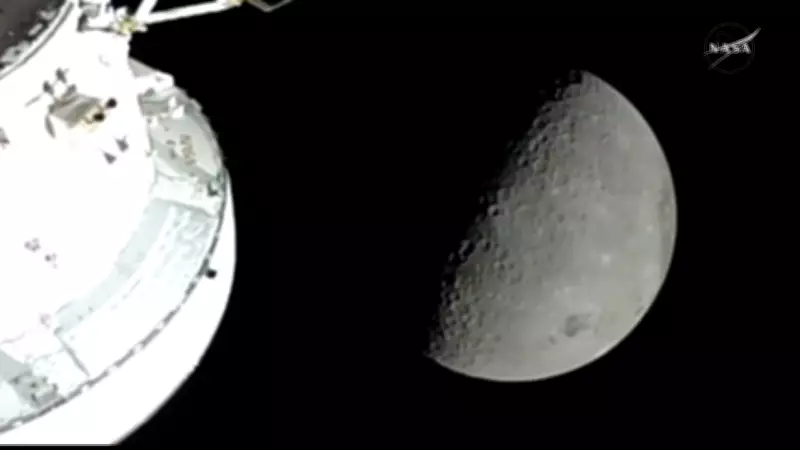
NASA Astronauts Honor Late Wife with Lunar Crater Naming on Historic Mission
Throughout human history, the Moon has served as a timeless symbol of love and longing. Poets have woven its silvery light into verses of romance, while lovers have gazed upon it for solace and inspiration. This celestial body, with its constant presence and gentle glow in the darkest nights, has long been the heart's most faithful companion.
From Poetry to Science: The Moon's Enduring Allure
This poetic fascination naturally evolved into scientific curiosity, a form of love in its own right. Space agencies began launching missions to the Moon, starting with robotic probes to map its surface—a realm already claimed by artists and writers. However, when human missions followed, they carried not just technology but also deep emotions, personal memories, and heartfelt stories.
A Record-Breaking Journey and a Heartfelt Tribute
On April 6, 2026, a profoundly moving story unfolded 252,756 miles from Earth. NASA's Artemis II mission, marking humanity's first crewed return to lunar vicinity since Apollo 17 in 1972, set a new record for the farthest distance humans have ever traveled from our planet. The four-person crew aboard the spacecraft Integrity—Commander Reid Wiseman, pilot Victor Glover, mission specialist Christina Koch, and Canadian astronaut Jeremy Hansen—floated in the vast silence between worlds.

As they gazed down at the ancient, crater-marked Moon, they noticed a small, bright, unnamed spot on the nearside boundary, visible from Earth at certain times. It was Jeremy Hansen who broke the radio silence, his voice thick with emotion, to propose naming this crater after Carroll Taylor Wiseman, Reid's late wife who died of cancer in 2020.
Hansen stated to Mission Control: "We lost a loved one years ago—Carroll, spouse of Reid, mother of Katie and Ellie. It's a bright spot on the Moon, and we'd like to call it Carroll."Love's Weightless Journey Through Space
Reid Wiseman, a former fighter pilot raising their two daughters alone, had carried his grief with the quiet efficiency of an astronaut. Yet, as this tribute revealed, love is never excess baggage—it travels across all 252,756 miles of space. After Hansen's announcement, Mission Control fell silent for forty-five seconds, a pause filled not with technical issues but with profound emotion.
In the Orion capsule, the crew embraced in weightlessness, while CapCom Jenny Gibbons responded softly, "Integrity and Carroll Crater. Loud and clear. Thank you." Tears flowed both on Earth and in space, as Carroll Wiseman, who never left our planet, was given a permanent home among the stars.
The Moon's Eternal Role as Love's Witness
This act reaffirms the ancient belief that the Moon is love's most faithful witness. Reid Wiseman and his crew simply flew close enough to prove it, blending science with sentiment in a historic moment that transcends exploration. The Carroll Crater now stands as a luminous testament to enduring love, visible from Earth and etched into lunar history forever.






