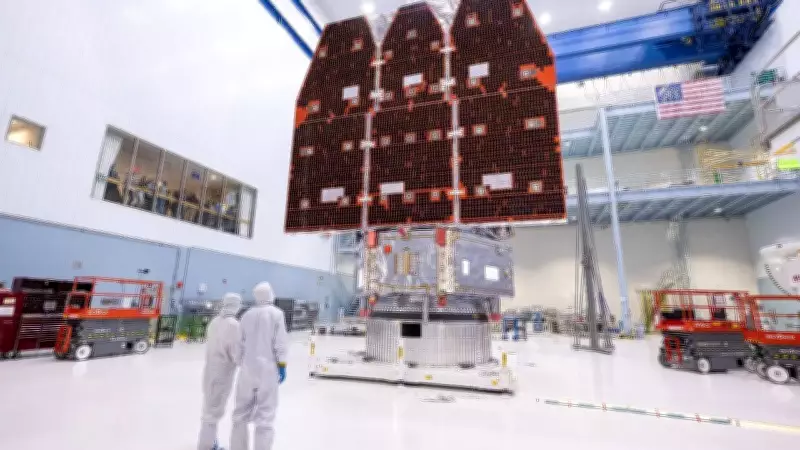
NASA Achieves Major Milestone with Complete Assembly of Roman Space Telescope
The Nancy Grace Roman Space Telescope has reached a pivotal moment in its development, with NASA officially confirming the completion of its final assembly at the Goddard Space Flight Center in Maryland. This observatory, widely regarded as the next significant advancement following the Hubble and James Webb Space Telescopes, is now fully constructed and entering the crucial phase of launch preparations, scheduled for 2026.
Engineering Triumph in Cleanroom Integration
Engineers recently finalized the integration of the telescope's primary systems within a large, meticulously controlled cleanroom environment, concluding years of intensive construction work. This achievement represents one of the most critical milestones in the mission's extensive timeline, transitioning Roman from the assembly stage to comprehensive testing and launch readiness.
Inside the Goddard facility, the telescope stands as a fully assembled structure, equipped with solar panels, advanced optical systems, and highly sensitive scientific instruments. The integration process successfully merged the spacecraft and telescope modules, ensuring all components function cohesively in preparation for space operations.

Unprecedented Survey Capabilities and Scientific Objectives
The Roman Space Telescope is designed to scan enormous regions of the sky in both visible and near-infrared light, generating data on a scale never before accomplished. NASA scientists emphasize that this capability could unlock new pathways in understanding fundamental cosmic phenomena, including:
- Dark Energy and Dark Matter: Roman will not directly detect these elusive components but will map the distribution and movement of galaxies over time. By constructing detailed 3D maps of the cosmos, researchers aim to refine models of cosmic expansion and the universe's accelerating growth.
- Galaxy Formation: The telescope's wide-field observations will provide insights into how galaxies assemble and evolve across cosmic history.
- Distant Planetary Systems: Equipped with a specialized coronagraph, Roman can block out bright starlight to image faint nearby objects, potentially allowing direct detection of large exoplanets like gas giants. This experimental technology may identify planets up to 100 million times dimmer than their host stars, advancing methods for future planet-hunting missions.
Revolutionary Observational Advantages Over Hubble
Roman is not intended to replace existing space telescopes but serves a distinct purpose with unique capabilities. While its primary mirror measures approximately 2.4 meters wide—similar to Hubble's—its field of view is dramatically broader. Each image will cover an area of the sky about 100 times larger than what Hubble can capture in a single shot, enabling astronomers to study the universe in entirely new ways.
NASA reports that during survey operations, Roman can collect data roughly 1,000 times faster than Hubble. Additionally, its ability to repeatedly observe large sky areas will help scientists detect transient cosmic events, such as supernovae, that might otherwise go unnoticed. Researchers anticipate thousands of supernova detections throughout the mission, enhancing our understanding of stellar life cycles.
Launch Preparations and Future Trajectory
The Roman Space Telescope is slated to launch aboard a SpaceX Falcon Heavy rocket. Following launch, it will journey nearly one million miles from Earth to Lagrange Point 2, a stable orbital location that minimizes interference from Earth and the Sun, providing an ideal environment for precise observations.
Before launch, the telescope will undergo rigorous final testing, including vibration and thermal simulations that replicate the extreme conditions of space travel. These tests are designed to ensure the system's durability during launch and reliable operation once deployed. After successful completion, Roman will be transported to the Kennedy Space Center for final pre-launch preparations.
This milestone underscores NASA's ongoing commitment to advancing space exploration and astrophysical research, positioning the Roman Space Telescope as a transformative tool for unraveling the mysteries of the cosmos.