Kolkata Airport's Advanced Tech Keeps Skies Open in Dense Fog
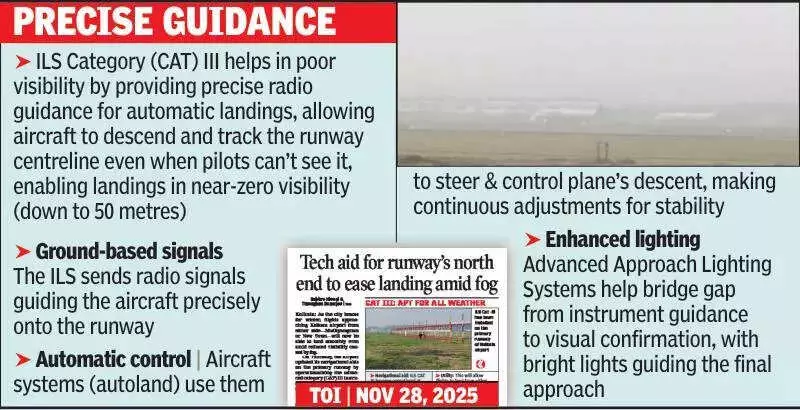
This winter, the Netaji Subhas Chandra Bose International Airport in Kolkata has emerged as a critical hub of reliability, thanks to its sophisticated Category III Instrument Landing System (ILS). While dense fog disrupted air travel across the eastern region, Kolkata's primary runway continued operations without interruption, bailing out numerous flights that were turned away from other major airports.
Foggy Mornings and Seamless Landings
The airport's capabilities were put to the test in the early hours of a recent Thursday. Around 2:32 am, the runway visual range—a crucial measure of visibility for pilots—dropped to approximately 550 meters. This triggered the implementation of low visibility procedures. Despite the challenging conditions, the CAT-III ILS installed on the primary runway enabled flights to land and take off safely.
An airport official confirmed that the facility has not yet faced the season's worst fog. "Only on one day, visibility was poor between 2.32 am and 4.05 am. But we are confident that even when there is thick fog, we will be able to carry on operations till visibility drops below 50 meters," the official stated.

A Regional Lifeline: Handling Diversions from Dhaka and Guwahati
Kolkata's operational resilience proved vital for the entire region. Neighboring major airports in Dhaka, Bangladesh, and Guwahati, India, which lack similar CAT-III ILS infrastructure, were forced to divert flights due to poor visibility. Kolkata airport stepped in as a savior.
"On Thursday and Friday, Kolkata airport handled 18 diversions owing to dense fog over Dhaka and Guwahati. Of these, 11 were diverted from Dhaka and seven from Guwahati," revealed an official. This assistance did not go unnoticed by passengers. One flyer expressed gratitude on social media platform X, writing, "Thank you @AAI_Official, our true friend. When fog stopped planes from landing at night in Dhaka, Kolkata airport helped fast and gave a signal to land until the situation got better."
Passengers like Md Tariqul Islam, a Bangladeshi citizen on a diverted flight from Dhaka, shared their experiences. "Due to dense fog, four out of eight flights have landed in Kolkata again. It seems we're all heading towards Delhi now," he said.
Double-Ended Safety: How CAT-III ILS on Both Sides Boosts Reliability
A key factor in Kolkata's success is the installation of the CAT-III ILS on both ends of the primary runway. Typically, winter in Kolkata sees northerly winds, guiding flights to approach from the south over New Town and take off from the northern end. However, pilots emphasize that having the system at both ends is a game-changer for operational reliability and efficiency.
"If visibility goes down due to fog or heavy rain, flights can continue to operate irrespective of the wind direction. Since flights land against the wind, the airport can also change direction of operation according to the change in wind direction, without having to worry about visibility," explained a veteran pilot. This flexibility ensures that even if weather patterns shift, the airport can maintain a steady flow of traffic during critical low-visibility conditions.
The advanced system not only prevents cancellations and long delays but also solidifies Kolkata's position as a dependable aviation node in Eastern India, especially during the challenging winter months.