

Jupiter's Size Updated: NASA's Juno Spacecraft Reveals Slimmer Measurements
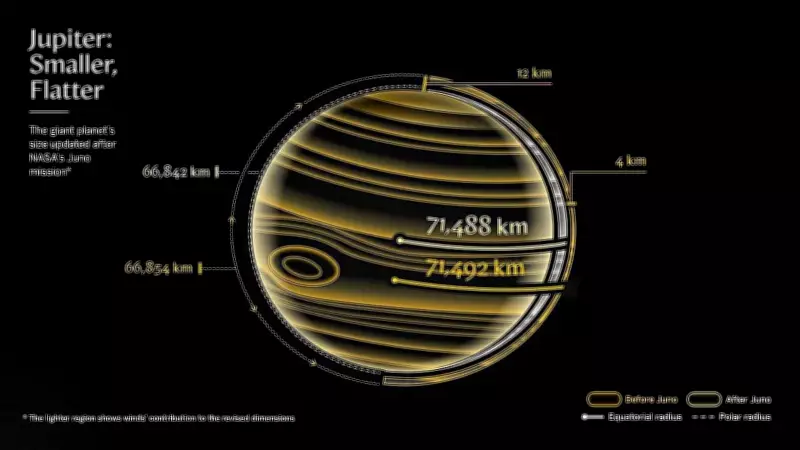
Scientists have announced a significant revision in the size of Jupiter, the solar system's largest planet, based on enhanced data from NASA's Juno spacecraft. New analysis indicates that Jupiter is slightly slimmer and flatter than previously estimated, providing fresh perspectives on its atmospheric dynamics and internal composition.
Precise Measurements from Juno's Mission
For decades, Jupiter's dimensions were derived from NASA's Voyager and Pioneer missions, which utilized radio occultation techniques to estimate the planet's size. However, these early readings did not fully account for Jupiter's intense winds, which can distort radio signals and affect accuracy. In contrast, NASA's Juno spacecraft, orbiting Jupiter since 2016, has delivered more detailed data through 24 new radio occultation readings.
Scott J. Bolton, Juno's principal investigator, explained in a NASA statement, "When the spacecraft moves behind the planet, its radio signal bends as it passes through the atmosphere. This gives us a very precise way to measure Jupiter's size." The updated measurements show Jupiter at approximately 83,067 miles from pole to pole and 88,841 miles across the equator, making it about 15 miles shorter at the poles and 5 miles slimmer at the equator than earlier estimates.

Implications for Planetary Science
While the size adjustments may seem minor relative to Jupiter's vast scale, they hold substantial importance for scientific understanding. Oded Aharonson, a planetary scientist not involved in the study, noted, "It's not just about knowing the exact radius. It helps us build better models of the planet's interior." The refined data enhances the alignment of Jupiter's gravity measurements with atmospheric observations, improving models of its deep structure.
Moreover, as Jupiter serves as a key reference for studying gas giants beyond our solar system, these findings could aid in better understanding exoplanets. The research, published on February 2 in the journal Nature Astronomy, underscores the value of ongoing space missions in refining our knowledge of celestial bodies.
Key Points from the Study
- Jupiter's revised size: 83,067 miles pole-to-pole and 88,841 miles equatorial diameter.
- Differences: 15 miles shorter at poles and 5 miles slimmer at equator compared to past estimates.
- Data source: NASA's Juno spacecraft, providing more precise readings than earlier missions.
- Impact: Improves models of Jupiter's interior and aids in studying other gas giants.
Despite the slight reduction, Jupiter remains the largest planet in the solar system by a significant margin, continuing to fascinate scientists and astronomers with its complex behavior and role in planetary science.






