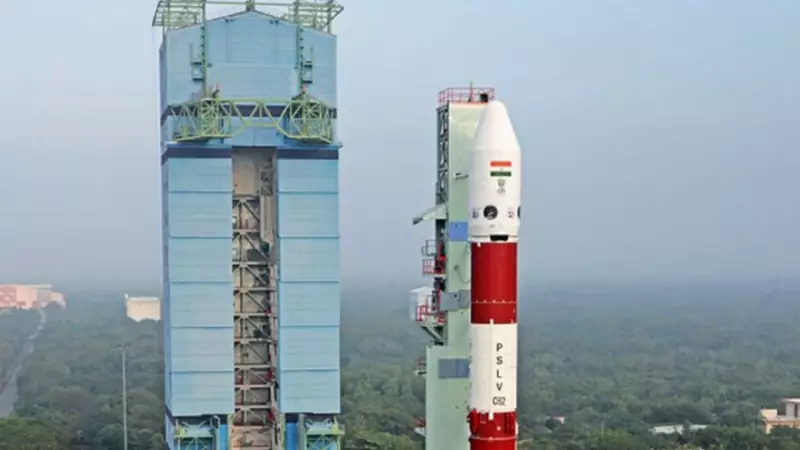
The Indian Space Research Organisation (ISRO) is poised to begin the new year with a significant launch, marking a determined return to flight after a previous setback. The PSLV-C62 mission is scheduled for liftoff at 10:17 am on Monday, January 12, 2026, from the First Launch Pad at the Satish Dhawan Space Centre in Sriharikota.
Primary Payload: The Advanced Eye in the Sky
At the heart of this mission is the EOS-N1 satellite, codenamed ‘Anvesha’. This is an advanced earth observation satellite developed primarily for the Defence Research and Development Organisation (DRDO). As a hyperspectral imaging satellite, Anvesha possesses a unique capability to "see" in hundreds of different wavelengths of light.
This advanced technology allows it to precisely identify materials and objects on the ground, far beyond the capabilities of standard optical cameras. It is therefore considered a high-priority national security and surveillance asset that will significantly boost India's border security and strategic monitoring from space.

Beyond defence, the satellite's sophisticated remote sensing data will also find applications in diverse civilian fields including agriculture, urban planning, and environmental observation.
A Diverse Fleet of Co-Passenger Satellites
The PSLV rocket will not be carrying the EOS-N1 alone. It will deploy a total of 18 secondary payloads alongside the primary satellite. The most notable among these is the European Kestrel Initial Demonstrator (KID).
The KID mission features an ambitious experiment: the controlled re-entry of a small capsule developed in collaboration with a Spanish startup. The capsule is planned to splash down in the South Pacific Ocean, testing technologies for future missions.
The ride also includes several cubesats from Indian academic institutions and private space startups, showcasing the growth of the domestic space ecosystem:
- AayulSAT by OrbitAID Aerospace (a historic on-orbit refuelling payload)
- CGUSAT-1 by CV Raman Global University
- DA-1 by Dhruva Space
- SR-2 by Space Kidz India
- Lachit-1 by Assam Don Bosco University
- Solaras-S4 by Akshath Aerospace
- DSAT-1 by Dayanand Sagar University
A Crucial Comeback for the PSLV Programme
This mission holds special significance as it represents a critical comeback for the reliable PSLV launch vehicle. The previous mission, PSLV-C61 in May 2025, ended in failure. During that launch, an anomaly occurred in the rocket's third stage—specifically, a drop in chamber pressure.
While the first two stages had performed flawlessly, this third-stage issue prevented the EOS-09 earth observation satellite from reaching its intended sun-synchronous polar orbit. The upcoming PSLV-C62 mission is thus being closely watched as ISRO aims to demonstrate the full rectification of the issue and restore confidence in its workhorse rocket.
The successful launch of PSLV-C62 will not only deploy a vital strategic asset but also reaffirm India's robust capabilities in space access and technology demonstration.