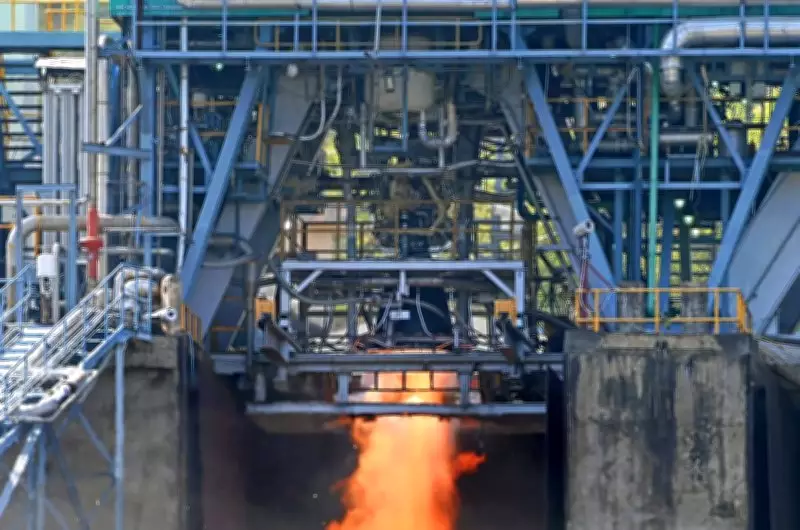
ISRO's CE20 Engine Tested at 22-Tonne Thrust, Elevating LVM3 Rocket Capabilities
The Indian Space Research Organisation (ISRO) has achieved a major milestone in space propulsion with the successful sea-level hot test of its CE20 cryogenic engine at an enhanced thrust level of 22 tonnes. This breakthrough significantly boosts the payload capacity of the Launch Vehicle Mark-3 (LVM3), India's heaviest operational rocket, paving the way for more ambitious space missions.
Minister Jitendra Singh Hails Critical Test Success
Union Minister of State for Science and Technology, Dr. Jitendra Singh, extended his congratulations to ISRO for this accomplishment. In a social media post, he emphasized that the test, featuring advanced technologies like a nozzle protection system and multi-element igniter, strengthens India's cryogenic propulsion capabilities and enhances the reliability of the LVM3 program.
The test was conducted on March 10 at the ISRO Propulsion Complex in Mahendragiri, utilizing the nozzle protection system and multi-element igniter to achieve the 22-tonne thrust. Previously, sea-level tests were limited to 19 tonnes, marking this as a substantial upgrade in performance.

Enhancing LVM3's Payload for Future Missions
ISRO has outlined plans to operate future LVM3 missions with an uprated C-32 stage, incorporating the 22-tonne thrust CE20 engine to increase payload capacity. The LVM3 is a three-stage rocket capable of launching over four tonnes to Geosynchronous Transfer Orbit and eight tonnes to Low Earth Orbit. With nine successful launches to date, including the Chandrayaan-2 and Chandrayaan-3 missions, this enhancement will further solidify its role in India's space exploration efforts.
The recent test qualified the engine for sea-level operation with a duration of 165 seconds at the higher thrust level, with both the engine and test facility performing as expected. This development is crucial for meeting the demands of upcoming missions that require greater payload capabilities.
Overcoming Technical Challenges in Cryogenic Testing
Testing the CE20 engine at sea-level presents significant challenges due to its high area ratio nozzle, which has an exit pressure of about 50 millibar. Key concerns include flow separation within the nozzle, which can lead to severe vibrations and thermal issues, potentially causing mechanical damage. The successful test demonstrates ISRO's ability to mitigate these risks through innovative engineering solutions.
The cryogenic engine used in this test has undergone a record 20 hot tests, enabling the validation of several critical technologies. These include:
- Engine ignition using a multi-element igniter.
- Ignition margin demonstration for the Gaganyaan mission across a wide range of propellant tank and pre-ignition chamber pressures.
- Engine qualification for Gaganyaan at 20-tonne thrust level.
- Demonstration and qualification of 22-tonne thrust level operation.
- Boot-strap mode starting of the CE20 engine without a start-up system for in-flight restart capability.
- Qualification of indigenous turbo-pump bearings, sensors, and nozzle protection systems for high area ratio nozzle hot tests at sea level.
This comprehensive testing regime underscores ISRO's commitment to advancing indigenous space technology and ensuring the reliability and safety of its launch vehicles for both scientific and human spaceflight missions.