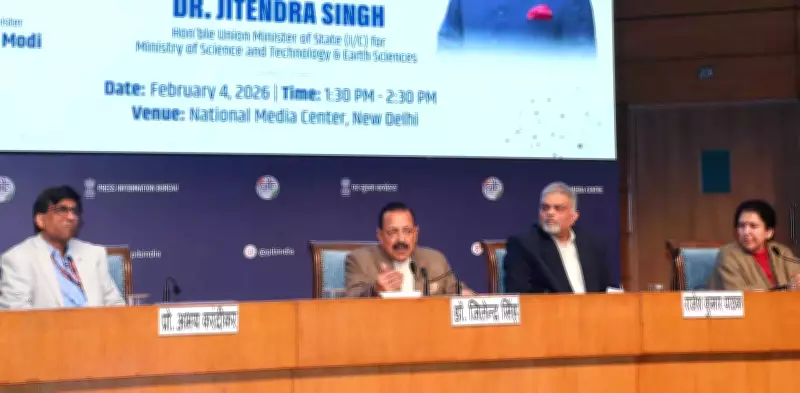
ISRO Minister Dismisses Sabotage Theories in Recent PSLV Launch Failures
Space Minister Jitendra Singh has categorically ruled out any possibility of sabotage in the two consecutive failures of India's Polar Satellite Launch Vehicle (PSLV) missions. The minister confirmed that separate internal and external failure assessment committees have been established to thoroughly investigate what went wrong during each of these critical space missions.
Timing of Statements Follows High-Level Security Visit
Interestingly, Minister Singh's statements on Monday came just days after National Security Adviser Ajit Doval reportedly made a secret visit to the Thiruvananthapuram-based Vikram Sarabhai Space Centre (VSSC) on January 22. This visit was purportedly conducted at the directive of Prime Minister Narendra Modi, highlighting the government's serious concern about the recent setbacks in India's space program.
Details of Recent PSLV Setbacks
The Indian Space Research Organisation (ISRO) faced a significant setback on January 12 when its workhorse launch vehicle PSLV-C62 encountered an anomaly during the third stage of its rocket launch. This mission was carrying the surveillance satellite EOS-N1 along with 15 co-passenger satellites. Tragically, fifteen satellites were lost in space, with only one satellite - a Spanish spacecraft named KID (Kestrel Initial Demonstrator) - successfully transmitting "critical data" for approximately three minutes before the mission failure.

Similarly, the PSLV-C61 launch in May of last year also failed due to a technical snag occurring in the third stage of the rocket. These back-to-back failures have raised concerns about the reliability of India's primary launch vehicle, which has historically boasted an impressive success rate of over 90%.
Minister's Analogy and Commercial Confidence
Minister Singh drew an interesting analogy to explain the different nature of the two failures. "What happened last time is not what happened this time," he stated, referring to the two successive PSLV failures. Using the metaphor of an electric bulb, the minister elaborated, "Last time the bulb fused, this time there was tripping outside."
Despite these technical setbacks, Singh emphasized that ISRO's commercial partners have maintained their confidence in the space agency. "None of them has shown any apprehension," he revealed, indicating continued trust in India's space capabilities among international collaborators.
Future Launch Schedule and International Collaborations
Looking ahead, Minister Singh outlined an ambitious launch schedule for the coming years. He explained that 18 launches are scheduled for 2026, including six missions to be conducted by private players. Importantly, none of these planned launches have been withdrawn following the recent PSLV failures.
For 2027, three key launches are scheduled from Indian soil involving foreign partners from the United States, Japan, and France, demonstrating continued international confidence in India's launch capabilities.
Next PSLV Launch Targeted for June
Regarding the immediate future of PSLV missions, Minister Singh announced, "Our probable next date, which we are very ambitiously targeting, is in June, after we screen the report of the committee and rectify everything." This announcement indicates ISRO's determination to address the technical issues promptly and resume successful launches with its primary workhorse vehicle.
The establishment of both internal and external failure assessment committees underscores the seriousness with which ISRO and the government are approaching these technical anomalies. These committees will conduct comprehensive analyses to identify root causes and implement corrective measures to prevent similar failures in future missions.