ISRO Chairman Affirms Development of Reusable Launch Technology, Dismisses Competitive View of SpaceX
In a significant statement regarding India's space ambitions, ISRO Chairman V. Narayanan has confirmed that the Indian Space Research Organisation is actively working on reusable launch vehicle technology. However, he emphasized that the agency does not consider private entities like SpaceX or other organizations as direct competitors in the global space arena.
Cost-Effectiveness and National Focus
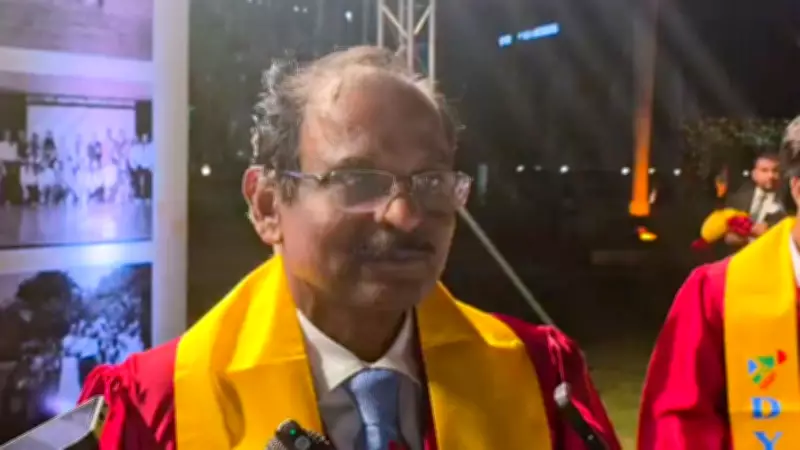
Speaking at the convocation of D.Y. Patil International University in Pune on February 5, Narayanan acknowledged the undeniable cost benefits of reusable rockets, exemplified by SpaceX's pioneering efforts. "No doubt when you go for reusable launches it will be cost effective. We are working towards reusable launch technology development," he stated in response to media queries.
He further clarified ISRO's perspective on competition, saying, "We don't consider this as competition. Because the Indian Space Programme is meant for India. Strength only respects strength, if you don't have a vibrant space programme no one is going to respect you. And right now we are serving the common man of the country." This underscores ISRO's mission-driven approach focused on national development rather than commercial rivalry.

Experimental Program and Learning from Setbacks
When questioned about the timeline for developing reusable launches, Narayanan revealed, "We only have an experimental programme so far and we are working towards that." This indicates that while progress is underway, ISRO is in the experimental phases of this advanced technology.
Reflecting on past missions, the Chairman highlighted how ISRO has transformed failures into learning opportunities. He specifically mentioned the Chandrayaan 2 mission in 2019, which aimed for a soft landing at the Moon's South Pole but resulted in a hard landing. "We took it as a great opportunity to learn lessons," Narayanan remarked.
He detailed the rigorous response: a 10-member committee was formed with strict terms of reference, tasked to deliver recommendations within 30 days. "The team did a fantastic job. Exactly 30 days, 5 hours before the deadline, I know 500 people sleeping only 3 to 4 hours per day, we submitted the report. And with more than 100 recommendations implemented, Chandrayaan 3 was a very grand, successful mission," he recounted, showcasing ISRO's resilience and systematic approach to problem-solving.
Recent Challenges and ISRO's Legacy
Despite its celebrated achievements, including the cost-effective Mars orbiter mission that had a budget lower than some Hollywood films, ISRO has faced recent technical hurdles. The organization experienced two consecutive failures with its reliable PSLV rocket within the past year.
- The first unsuccessful launch occurred in May 2025 when the rocket encountered issues during the third stage of launch.
- The second failure took place in January 2026 when PSLV-C62, carrying 16 satellites, also developed a snag in the third stage.
The Failure Analysis Committee report for these incidents has not been publicly released, maintaining a degree of confidentiality around the investigations.
Narayanan's comments come at a pivotal time as ISRO balances its legacy of affordable space exploration with the need to innovate in response to global advancements like SpaceX's reusable technology. His remarks reinforce that while cost efficiency is a priority, ISRO's primary allegiance remains to India's strategic and societal needs, fostering a collaborative rather than competitive stance in the international space community.