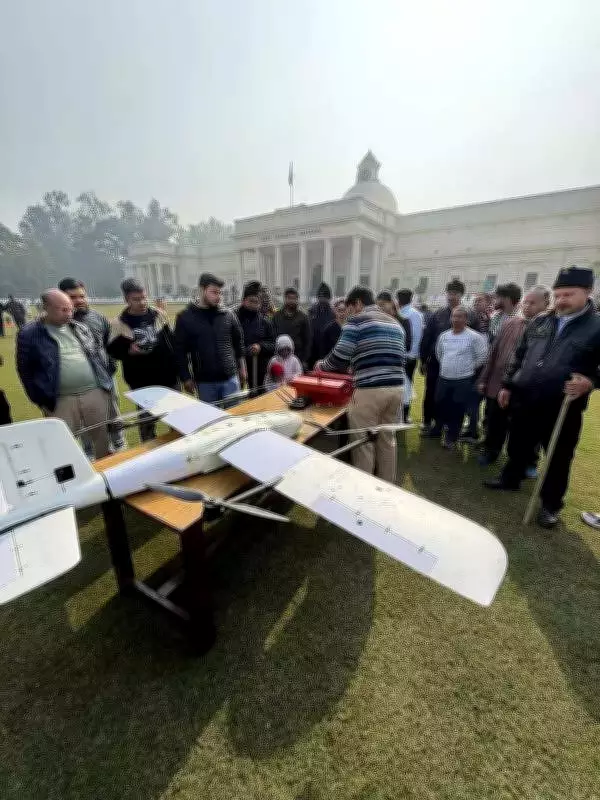
IIT Roorkee Pioneers Drone-Based Cloud Seeding Technology for Artificial Rainmaking
In a significant breakthrough for weather modification technology, scientists at the Indian Institute of Technology Roorkee (IIT-R) have developed an innovative drone-based method to enhance artificial rainmaking through cloud seeding. This advancement represents a major step toward creating more cost-effective and locally deployable weather-modification solutions that could transform agricultural practices across India.
Collaborative Experimental Trials and Initial Phase Success
The capability experimental trials were conducted in collaboration with Hyderabad-based technology firm AccelESG, combining academic research with industry expertise. During the initial phase, researchers flew drones at the permissible height of 100 meters to thoroughly assess system stability, dispersal mechanisms, and data-collection processes. This foundational testing phase has yielded promising results that demonstrate the viability of drone-assisted weather modification.
Innovative Use of Calcium Chloride Compound
The research team employed calcium chloride, a highly effective hygroscopic compound that actively attracts and absorbs moisture from the surrounding air. Professor A S Maurya, principal investigator from the institute's earth sciences department, explained the significance of their achievement: "This technology could help mitigate dry spells, improve soil moisture, and reduce farmers' dependence on groundwater for irrigation. We have successfully achieved weather-modification results in the laboratory, marking a crucial milestone in our research."

Seeking Regulatory Clearances for Higher Altitude Trials
The research team is now actively seeking clearances from the state government and various regulatory agencies, including local air traffic control authorities, to conduct more advanced trials at higher altitudes. Professor Maurya emphasized the importance of these permissions: "Such permissions are essential to evaluate the effectiveness of drone-based cloud seeding under real atmospheric conditions, where clouds form at much greater heights. This next phase will provide critical data about how our technology performs in actual weather systems."
Addressing Agricultural Challenges Through Precision Technology
The researchers highlighted how drone-assisted cloud seeding has the potential to address pressing local agricultural challenges, particularly in regions experiencing erratic rainfall patterns. Drones offer several distinct advantages over traditional methods:
- Precise targeting of specific cloud systems for maximum effectiveness
- Lower operational costs compared to aircraft-based seeding operations
- Rapid deployment capabilities during short-lived cloud formations that might otherwise be missed
Significant Impact Potential for Agricultural Regions
The scientists estimate that rainfall could potentially be induced over an area with a radius of nearly 10 kilometers through drone-based operations, making the technique particularly suitable for district- or block-level agricultural intervention. Such targeted rainfall enhancement could help bridge dry spells, improve soil moisture retention, and significantly ease pressure on groundwater resources that have been increasingly strained across agricultural regions.
Climate Context and National Significance
This initiative gains particular significance amid increasing climate variability and recurring rainfall deficits affecting farming communities across the country. While further trials and long-term monitoring are needed before large-scale deployment can be considered, the initial results point to promising possibilities for supplementing natural rainfall through scientific intervention. Professor Maurya proudly noted: "It is the first successful intervention of its kind among all IITs and other premier educational institutions in the country, representing a significant achievement for Indian scientific research."

The development of this drone-based cloud seeding technology at IIT Roorkee represents a convergence of meteorological science, agricultural needs, and technological innovation that could potentially transform how India approaches water security and agricultural sustainability in an era of climate uncertainty.