IIT Madras Researchers Pioneer Objective Measurement Tool for Laparoscopic Surgical Skills
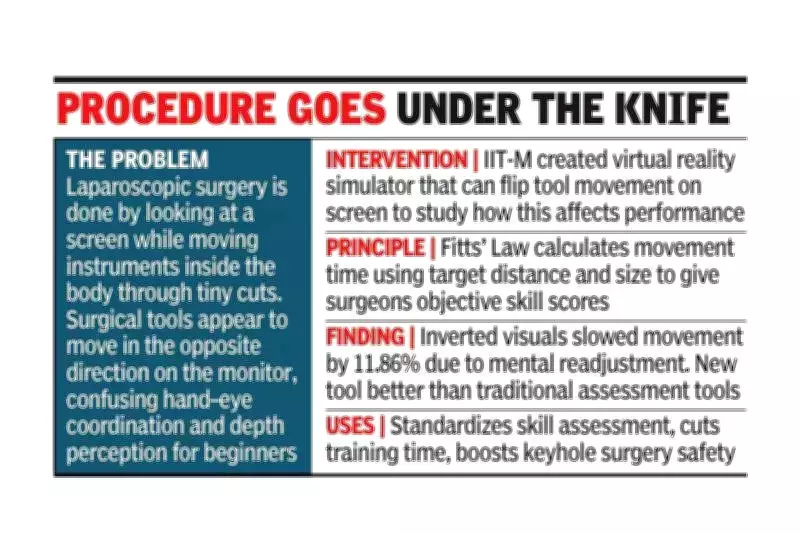
In a significant advancement for medical training, researchers at the Indian Institute of Technology Madras have developed a groundbreaking tool that provides objective measurement of surgeons' performance during laparoscopic procedures. This innovation promises to standardize how surgical skills are taught and evaluated globally, addressing long-standing challenges in minimally invasive surgery training.
The Unique Challenges of Laparoscopic Surgery
Laparoscopic surgery, commonly referred to as keyhole surgery, is extensively used for procedures such as gallbladder removals and bariatric weight-loss operations. This approach presents distinct difficulties for surgeons who must operate through tiny incisions using elongated instruments while watching their movements on a monitor.
The fulcrum effect creates particular complications, as explained by Professor Manivannan M, head of IIT-M's Touch Lab in the Department of Applied Mechanics and Biomedical Engineering. "When surgeons insert instruments through these small cuts, they pivot at the entry point. This causes an inversion where moving the hand left makes the tool tip move right, demanding significant mental remapping that slows surgical tasks by forcing additional brain processing," he stated.

Beyond the fulcrum effect, laparoscopic procedures also limit tactile feedback, complicate depth perception, and create mirror movements that challenge even experienced surgeons.
Moving Beyond Subjective Evaluation Methods
Traditional surgical training programs have relied heavily on subjective evaluation tools to help surgeons overcome these hurdles. While structured, these methods depend extensively on instructors' personal judgments, leading to considerable variability in scoring precision, efficiency, tissue handling, and overall surgical competence.
The IIT Madras research team took a fundamentally different approach by drawing on computer science principles to create a more reliable assessment system. They applied Fitts' Law—a well-established concept from human-computer interaction that predicts movement time based on target distance and size—to design a custom virtual reality haptic simulator.
The VR Haptic Simulator: How It Works
This sophisticated system replicates authentic laparoscopic conditions, including inverted visuals that mimic actual surgical environments. The technology quantifies performance through precise metrics such as movement time and throughput during standardized tapping tasks, providing consistent, data-driven scores that eliminate subjective bias.
The research, published in the peer-reviewed International Journal of Human–Computer Interaction, demonstrated compelling results. Scientists tested the model on 24 young surgeons and discovered that inverted tool visuals increased movement time by an average of 11.86% compared to non-inverted movement scenarios.
Bridging Disciplines for Global Impact
Dr. Venkatraman Sadanand, the study's co-author and a US-based senior neurosurgeon who graduated from IIT-M as an electrical engineer, emphasized the interdisciplinary nature of this breakthrough. "This research bridges computer science, engineering, and neurosurgery, setting the stage for global adoption of standardized virtual reality assessments that could revolutionize minimally invasive training worldwide," he explained.
The innovation arrives at a critical time for India's healthcare system, which faces surgeon shortages alongside rising demand for minimally invasive procedures. This technology could accelerate skill development, reduce training costs, and significantly improve patient safety outcomes.
Future Research Directions
While the initial results are promising, scientists acknowledge that larger trials on the scoring system will be necessary to validate findings across different experience levels and surgical specialties. The research team plans to expand testing to ensure the tool's effectiveness and reliability in diverse clinical settings.

This development represents a major step forward in surgical education, potentially transforming how future generations of surgeons are trained and evaluated in the increasingly important field of minimally invasive medicine.