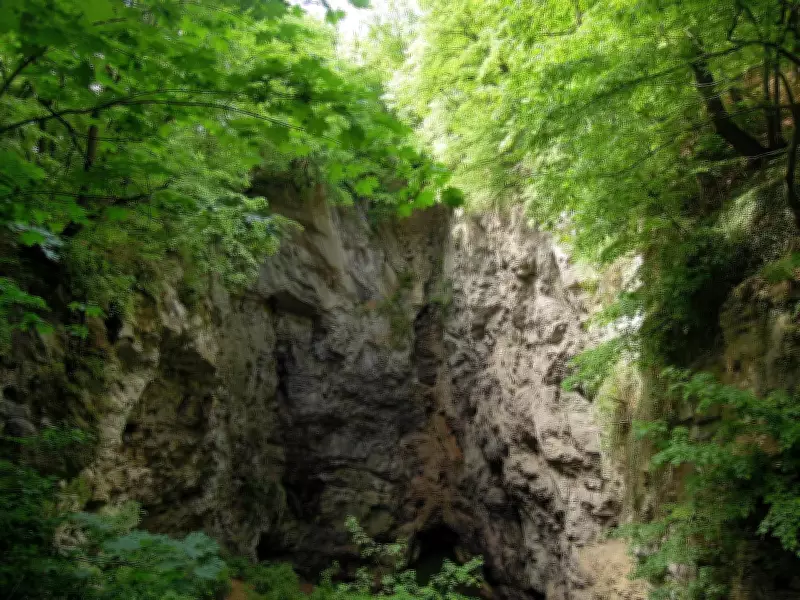
Hidden deep within a quiet forest in the Czech Republic lies an unassuming pool that holds a profound mystery. At first glance, it resembles any other natural pond, but beneath its surface, a vertical shaft plunges into an abyss. This location has long fascinated divers and researchers, as it is recognized as the world's deepest explored water-filled cave. What makes it even more intriguing is not just what has been discovered, but what remains unknown.
A Challenge for Humans and Machines
This is more than a story of an Earthly abyss; it is a test for humanity and technology. Studying such a cave system involves mapping depths comparable to skyscrapers, all while navigating pitch-black, acidic water under immense pressure, with passages narrowing to dangerous widths. Today, we stand at the boundary between an era of manual human exploration and a new age of deep Earth science driven by robotics.
A Deep Record with an Invisible Bottom
The Hranice Abyss has gained increasing attention due to the vast difference between known data and the potential depth beyond the current record. Once a local curiosity, the cave gained global notice after new technologies revealed its true scale. A comprehensive 2020 study published in the Journal of Geophysical Research: Earth Surface provided the most detailed view yet of this subterranean giant. Researchers employed geophysical tools such as gravity measurements and seismic reflection to probe depths unreachable by humans. They confirmed an explored depth of 473.5 meters, but the data hinted at something far deeper. The study suggests the cave system could extend to roughly one kilometer, making it nearly three times the height of the Eiffel Tower, all submerged vertically underground.

This finding overturned previous assumptions about cave formation. While most caves form from the top down, as rainwater erodes rock, Hranice appears to originate from below, created by hot, carbon dioxide-rich groundwater. This bottom-up formation accounts for its immense depth and the difficulty of access. The cave acts as a chimney for Earth's internal chemistry, and mapping its full extent requires plumbing the planet's crust.
Why Robots Are Taking Over the Descent
With no viable way for humans to reach the bottom, the solution lies in robotics. The harsh conditions have turned the cave into a testing ground for autonomous systems that must operate without surface communication or GPS. The technology required is similar to that developed for the CERBERUS system in the DARPA Subterranean Challenge, which focused on creating robots capable of navigating unstructured environments with uneven terrain, tight spaces, and no preexisting maps. While that challenge often involved dry tunnels, the core problem is identical: a machine must build a 3D map in real time while avoiding obstacles that could snag a cable or crush its hull.
Using autonomous eyes, scientists hope to finally close the gap in the map. A robot does not tire, does not need to breathe, and can carry sensors that see through murky water using sound and light. The mystery of the Hranice Abyss is now as much an engineering race as a geological one. Until a machine successfully navigates the deepest, narrowest passages, the true bottom will remain one of Earth science's quietest open questions.
The Drive to Understand
Each expedition into the mysterious darkness is motivated by our desire to understand. We seek the edges of a map that continues to expand, a stark reminder that even in today's advanced world of cartography, there are still blind spots waiting to be charted.