

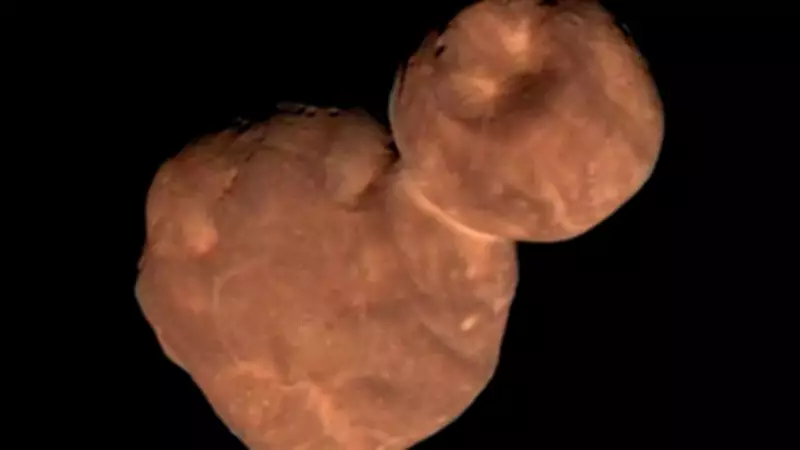
Michigan State University Solves Cosmic 'Snowman' Mystery Through Gravitational Collapse
For decades, astronomers have been puzzled by the peculiar "snowman" shaped objects floating in the frigid depths of the Kuiper Belt beyond Neptune. These double-lobed contact binaries, like the famous Arrokoth discovered by NASA's New Horizons mission, appear fragile yet have survived billions of years of cosmic history without disintegrating. Now, researchers at Michigan State University have finally cracked this celestial mystery.
The Breakthrough Simulation
Graduate student Jackson Barnes has developed the first computer simulation demonstrating how these contact binaries form naturally through gravitational collapse. His groundbreaking work, published in the Monthly Notices of the Royal Astronomical Society, reveals that swirling clouds of millimeter-sized pebbles in the early solar system collapse under their own gravity to create these distinctive two-lobed structures.
"If we think 10% of planetesimal objects are contact binaries, the process that forms them can't be rare," said Seth Jacobson, Assistant Professor of Earth and Environmental Science at MSU and senior author on the paper. "Gravitational collapse fits nicely with what we've observed."

How Gravitational Collapse Creates Cosmic Snowmen
The process begins with pebble clouds concentrating through streaming instability in protoplanetary disks. When self-gravity overwhelms other forces, the cloud collapses. Barnes' simulation of 54 initial pebble clouds containing 105,105 particles each showed that two small planetesimals from the collapsing cloud can enter mutual orbit, spiraling inward gradually at velocities of 5 meters per second or less before gently touching.
"Some of the contact binaries in our model bear a striking resemblance to Arrokoth," Barnes remarked about the simulation results. Unlike previous models that treated colliding planetesimals as fluid-like blobs merging into smooth spheres, Barnes' innovation modeled how pebbles actually rest and adhere upon contact, explaining how the intact snowman shapes persist.
Real-World Observations and Implications
The discovery aligns perfectly with observations of Arrokoth, which NASA's New Horizons spacecraft revealed as a low-density, loosely bound "rubble pile" structure when it flew past the Kuiper Belt object in January 2019. The fact that contact binaries make up approximately 10% of Kuiper Belt objects suggests gravitational collapse in pebble clouds was a common process throughout our solar system's formation.
Similar shapes appearing among near-Earth asteroids imply this gentle formation mechanism operated solar system-wide. This work represents a transformational view of planetesimal formation, showing how resilient structures can emerge from cosmic dust through purely gravitational processes without requiring violent collisions.
Future Research Directions
As computing power advances, higher-resolution pebble cloud models promise even deeper insights into planetary formation. Future space telescopes like the James Webb Space Telescope may detect more contact binaries in distant protoplanetary disks, potentially confirming that this formation mechanism operates around other stars as well.
Jackson Barnes' simulation not only solves the long-standing mystery of how cosmic snowmen form but fundamentally redefines our understanding of how planetesimals—and ultimately planets—emerge from the swirling dust of young solar systems.






