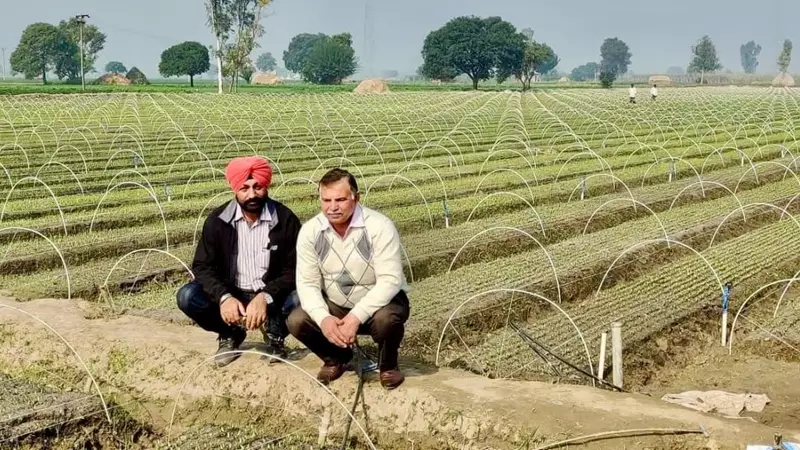
In the heart of Dadlu village, nestled within Shahbad Markanda in Kurukshetra, a quiet agricultural revolution is taking root. Harbir Singh Toor, a 49-year-old farmer, has become a nationally recognized name in India's horticulture sector by building an empire that sells a staggering 10 crore (100 million) vegetable nursery plants annually.
From Political Science to Plant Science: An Unlikely Journey
Toor's farming career began in 1995, a time when he was simultaneously pursuing a post-graduation in Political Science. Like many in his region, he started with conventional crops such as wheat and paddy. However, he quickly grew disillusioned with the limited returns and lack of innovation in traditional farming. This dissatisfaction sparked a quest for more versatile and profitable agricultural avenues.
His initial foray into diversification included a successful stint in beekeeping, which was later abandoned due to family constraints. Undeterred, he turned his attention to vegetable cultivation on a small plot. This experience opened his eyes to the vast potential and dynamism of the field. In 2003, he took a decisive leap into vegetable nursery cultivation, starting on a modest two kanals (about a quarter of an acre) of land.

Building a Horticulture Empire Through Innovation
Toor's expansion was rapid and strategic. Within five years, his nursery operation grew to encompass 16 acres. A pivotal moment in his journey was a frustrating visit to a large corporate nursery in Jalandhar, where he was denied entry and proper guidance. This experience solidified his resolve to create a nursery that would not only provide high-quality seedlings but also offer genuine guidance to fellow farmers.
His business model is sharply focused on market demand. "Our focus is on producing seasonal vegetables that are in high demand," Toor explains. His nursery boasts a diverse catalog, including tomatoes, onions, multi-coloured capsicum, chilli, karela (bitter gourd), tori (ridge gourd), and various melons. His planting schedule is meticulously planned to ensure the right crops, like onions and late-season tomatoes, hit the market at the optimal time from November to March.
Global Recognition for Sustainable Practices
Perhaps the most groundbreaking aspect of Toor's success is his commitment to sustainable innovation, particularly in irrigation. He employs sprinklers, low tunnel farming, and other precision techniques. His signature innovation, however, is a unique growing medium—a carefully calibrated mixture of burnt rice husk, river sand, and biogas waste from his own plant.
This medium is a game-changer in water conservation. "After germination, there is no need for extra watering. Air moisture is sufficient for the plants," he states. The mixture retains atmospheric moisture, drastically reducing water dependency. This revolutionary method garnered international attention, leading to an invitation for Toor to present his findings at the World Horticulture Centre in the Netherlands in February 2023.
Toor's contributions have not gone unnoticed at home. He is the recipient of prestigious awards like the Kisan Ratan, Nursery Ratan, and the N G Ranga National Award from ICAR in 2017. Today, he is not just a businessman but an educator, collaborating with universities, training agricultural students, and delivering lectures. His future ambitions are clear: to develop cost-effective irrigation systems for small farmers and expand into fruit and tissue-culture plants, continuing a journey defined by experimentation, persistence, and remarkable success.