'The Times of India' brings you 'Hack of the Day' — a new weekday series of quick, practical solutions to everyday hassles. Each hack is designed to save you time, money or stress, using tools and features within your reach — from government websites to everyday apps. In simple words: Simple fixes for smarter living.
Why Check Air Quality Before Outdoor Activities?
Planning a morning walk, cycling session or outdoor workout? A quick check of air quality could help you avoid spending time outside when pollution levels are high. Google offers air quality information directly through Google Maps and Search, making it easy to see current Air Quality Index (AQI) levels before stepping out. This feature is especially useful for people with asthma, allergies or other respiratory conditions, as well as anyone looking to reduce exposure to polluted air during daily commutes or exercise. Here's a simple trick that can help you choose a cleaner time or location for your outdoor plans.
What Are Air Quality Scales?
Countries or regions define air quality indexes and categorize raw data into descriptive rating scales. These indexes make it easier to identify pollution levels and associated risks. Different countries and regions use different scales based on local pollution and health considerations. There are dozens of local indexes used globally. For example, some states in Australia use a number-based system while others use a category-based system. Canada, the US, and Japan define separate air quality indexes, as does the European Environment Agency. As air pollution worsens, public health risks increase, especially affecting children, older adults, and other at-risk populations. During poor air quality, governmental agencies provide health recommendations regarding indoor and outdoor activities.

How Air Quality Indexes Are Calculated
The Air Quality Index (AQI) is how different governments communicate air quality to the public. It converts levels of different pollutants into one digestible index. Common differences between indexes include:
- Number and type of pollutants: Different AQIs are based on different individual pollutants. Common tracked pollutants include Particulate Matter (PM2.5 and PM10), Ozone (O3), Nitrogen Dioxide (NO2), Sulfur Dioxide (SO2), and Carbon Monoxide (CO). Different countries measure different pollutants. For example, the European AQI reports on all six mentioned, while the India AQI also includes ammonia (NH3).
- Averaging times: Many official sources provide reporting based on averaged readings for defined time frames, ranging from 1 to 24 hours.
- Pollutant concentration thresholds: Different AQIs apply their own interpretations of danger to different pollutant concentration levels.
- Dominant pollutants: AQIs define the dominant pollutant based on risk of exposure, i.e., which pollutant is harming health the most at a given time. As AQIs assign different interpretations of danger to individual pollutants, differences in dominant pollutant can occur.
Factors Influencing Air Quality
Although complex, air quality is influenced by several factors: weather conditions like wind speed and direction, and relative humidity; solar irradiance; wildfires and other types of fires; agriculture dust storms and dust emissions; industry and private household emissions; traffic emissions; and other physical and chemical atmospheric processes.
How AQI Near You Is Selected
Air quality levels are calculated based on measurements from air quality stations. Google provides a map of all stations in your area for a comprehensive picture. However, air quality between stations may vary, and the AQI at the closest station may not reflect your specific location. To avoid confusion, a map-based view displays AQI levels at stations around you. Due to space constraints, some Google products show a single-station reading, selecting the value from the station closest to your location.

How to Check Air Quality Using Google Maps
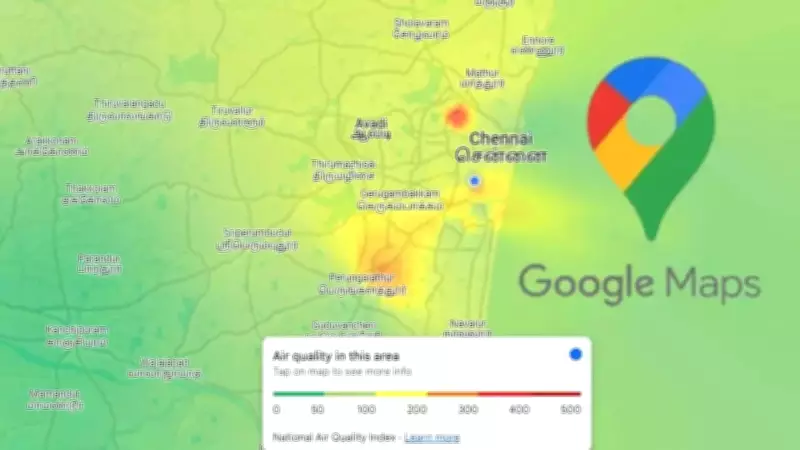
To show air quality at your location, Google applies its air quality model. If viewing air quality for a city, like 'weather in New Delhi,' the reading may be for a location far away, like the city center, which may not accurately reflect your situation. To get AQI for your location: sign in to Google Maps, on the location header select 'Choose area,' and use precise location by changing your location settings.
About the Author: Neha Saini, an English Honours graduate, pursued journalism to strengthen her writing dream. She has started her journalistic career as a tech-journalist.