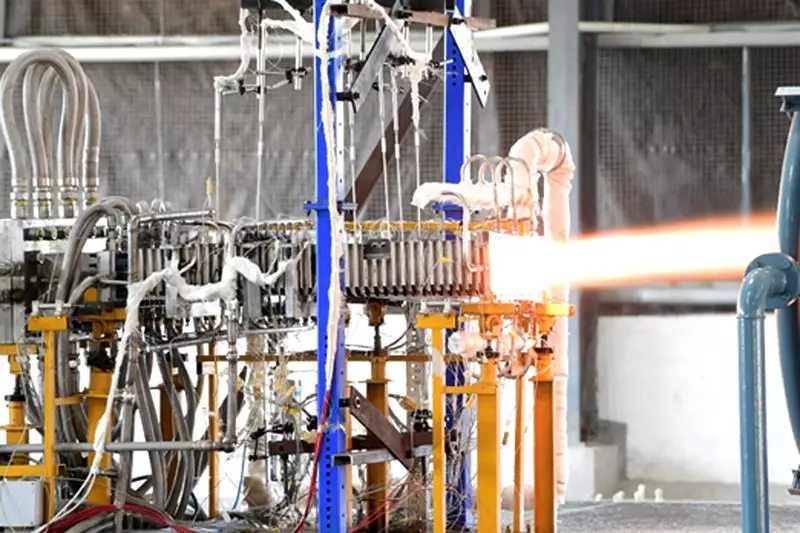
In a significant stride for India's defence capabilities, the Defence Research and Development Organisation (DRDO) has successfully conducted a ground test of its indigenously developed scramjet engine. This critical test, carried out at the DRDO's Hyderabad facility, marks a pivotal advancement for the nation's ambitious hypersonic missile programme.
A Technological Milestone for Indigenous Defence
The successful test of the scramjet (supersonic combustion ramjet) engine is a cornerstone achievement. Unlike conventional rocket engines that carry their own oxidiser, scramjet engines breathe atmospheric air, making them far more efficient for sustained flight at hypersonic speeds—defined as speeds greater than Mach 5, or five times the speed of sound. This test validates the complex technology that allows combustion to occur in a supersonic airflow, a formidable engineering challenge.
The development and testing were spearheaded by the DRDO's Hyderabad-based laboratory, a key centre for advanced propulsion research. While the exact date of the test was not publicly disclosed in the immediate release, the announcement confirms the system's performance and readiness for the next stages of development.

Paving the Way for Hypersonic Cruise Missiles
This breakthrough directly feeds into India's quest to develop hypersonic cruise missiles. Such missiles, powered by scramjet engines, would be capable of travelling at immense speeds, making them extremely difficult for existing enemy air defence systems to intercept. The successful ground test proves the core propulsion technology, moving the programme from theoretical research into a tangible hardware demonstration phase.
The implications for national security and strategic deterrence are substantial. Possessing hypersonic weapon technology would place India among a select group of nations with this advanced capability, significantly enhancing the precision and reach of its defence arsenal. It represents a move towards self-reliance (Atmanirbharta) in cutting-edge defence systems.
Strategic Implications and Future Trajectory
The success of this test is not an isolated event but a key component of India's broader defence modernisation. It demonstrates the DRDO's growing proficiency in mastering complex, next-generation technologies. The data gathered from this ground test will be invaluable for refining the engine design, optimising its performance, and integrating it into a flight vehicle.
The next logical steps will involve more extensive testing, potentially leading to flight tests of a prototype hypersonic technology demonstrator vehicle. This achievement strengthens India's position in the global strategic landscape and underscores its commitment to developing a credible and advanced defence infrastructure. The focus now shifts to accelerating the programme to achieve operational capability in the coming years.