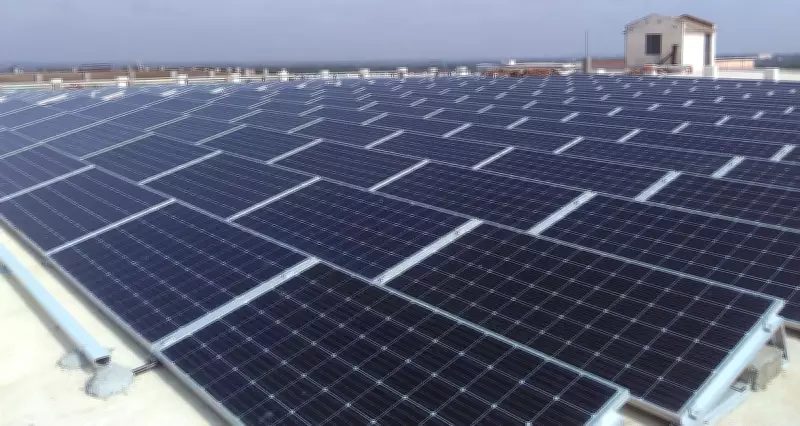
New rooftop solar installations in India have dropped sharply over the past month due to a government mandate requiring the use of domestically manufactured solar cells and modules, according to industry data and developer feedback.
Installation Slowdown
Data from the Solar Energy Corporation of India shows that new rooftop solar projects commencing operations fell by 30% in June 2026 compared to the monthly average in the first quarter of the year. Developers attribute this directly to the domestic content requirement (DCR) policy, which was tightened in April 2026.
"The DCR rule has created a supply bottleneck. Domestic manufacturers cannot ramp up production fast enough to meet demand, especially for high-efficiency modules needed for rooftop systems," said Rajesh K. Sharma, CEO of SunGrid Energy, a Bengaluru-based solar installer.

Policy Details
The Ministry of New and Renewable Energy mandated that from April 1, 2026, all rooftop solar projects under 10 kW capacity must use solar cells and modules made in India. Larger projects must also meet a phased manufacturing program. The policy aims to reduce import dependence, particularly on Chinese components.
However, industry bodies like the National Solar Energy Federation of India have warned that domestic production capacity for advanced photovoltaic cells is only about 8 GW per year, while annual rooftop demand is projected at 12 GW for 2026-27.
Impact on Consumers
The slowdown has left many residential and commercial consumers in limbo. In Bengaluru, home to one of the largest rooftop solar markets, over 2,000 applications for net metering connections are pending with the electricity utility BESCOM, awaiting completion of installations.
"We signed a contract in March expecting installation by May. Now the installer says they can't get domestic panels until August. We are losing savings on our electricity bill," said Priya Menon, a homeowner in Whitefield.
Government Response
The Ministry of New and Renewable Energy has acknowledged the supply constraints. A senior official, speaking on condition of anonymity, said the government is considering a temporary relaxation: "We are in talks with manufacturers to boost capacity. If the trend continues, we may allow a limited import window for six months."
Meanwhile, the Solar Energy Corporation of India has invited bids for setting up 2 GW of new domestic solar cell manufacturing capacity under the Production Linked Incentive (PLI) scheme, but these plants will take 12-18 months to become operational.