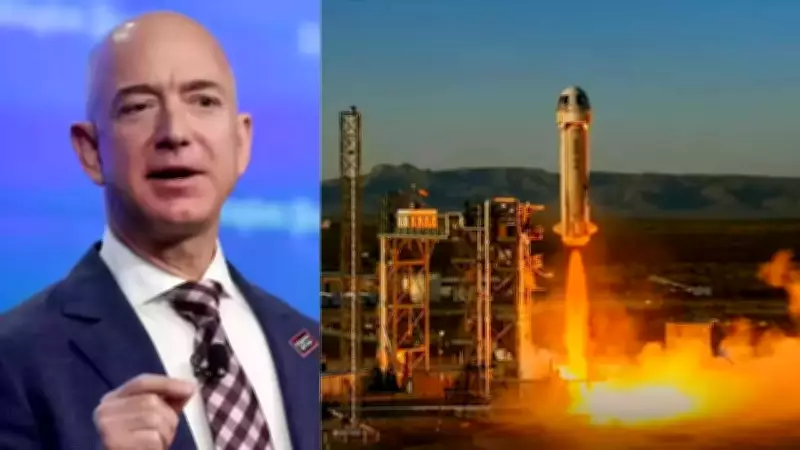
In a significant strategic shift, Blue Origin, the aerospace company founded by Amazon billionaire Jeff Bezos, has announced a temporary suspension of its space tourism operations. The company will pause flights on its New Shepard reusable rocket system for a minimum of two years, reallocating critical resources and engineering talent to support NASA's ambitious lunar exploration goals.
Focusing on America's Lunar Ambitions
Blue Origin confirmed in an official blog post that it is halting New Shepard launches to concentrate fully on the national objective of returning astronauts to the Moon and establishing a sustained human presence there. "Resources will be redirected to further accelerate our lunar human flight program," the company stated, emphasizing its commitment to this pivotal space exploration milestone.
Impact on New Shepard's Legacy
This decision directly affects the pioneering New Shepard vehicle, which has achieved remarkable milestones since its inception. To date, this vertical takeoff and landing system has completed 38 successful flights, carrying 98 individuals beyond the Kármán line—the internationally recognized boundary of space at 62 miles altitude.

Among its notable passengers have been high-profile figures including Bezos's wife, Lauren Sanchez, media personality Gayle King, and pop superstar Katy Perry. Beyond human spaceflight, New Shepard has launched more than 200 scientific and research payloads from students, academic institutions, research organizations, and NASA itself.
Technical Specifications and Operational History
The New Shepard rocket follows a distinctive suborbital trajectory rather than achieving Earth orbit like its larger sibling, the New Glenn vehicle. During typical missions, a crew capsule atop the rocket ascends to approximately 62 miles before descending under parachutes for a gentle landing. Meanwhile, the reusable booster employs sophisticated guidance fins and engine firings to execute precise soft landings on designated pads.
Blue Origin has cultivated substantial expertise through New Shepard operations. The rocket's BE-3 engine variant now powers the second stage of the New Glenn rocket, while experience gained from landing New Shepard boosters contributed to Blue Origin successfully landing a New Glenn booster on a floating barge during only its second test flight last year.
Financial Context and Market Dynamics
While Blue Origin has never publicly disclosed pricing for New Shepard seats, industry analysts estimate that if average tickets cost around $1 million, the 98 passengers to date would have generated less than $100 million in revenue. This amount pales in comparison to the company's $3.4 billion NASA contract for developing Artemis lunar landers.
The space tourism sector faces broader challenges, with Virgin Galactic—Blue Origin's primary competitor—also pausing flights of its operational spaceplane to focus on developing next-generation vehicles capable of carrying six passengers instead of four. Both companies have struggled to achieve the launch frequencies necessary to clear their substantial customer waiting lists.
NASA's Artemis Program Acceleration
Blue Origin holds a crucial NASA contract to provide human landing systems for the Artemis program, initially targeting the Artemis V mission in the 2030s. However, recent developments have prompted NASA to request both Blue Origin and SpaceX to explore accelerated development paths for earlier Artemis missions.
SpaceX, developing a Starship variant as the lander for Artemis III and IV, has encountered technical delays. NASA Administrator Jared Isaacman confirmed, "We are absolutely moving forward with both acceleration paths in parallel. We need to do everything we can to help them." This urgency aligns with political objectives, as the current administration aims for Artemis III to launch by the end of 2028.
Safety Record and Future Prospects
New Shepard has demonstrated generally reliable performance, though it experienced a booster failure during an uncrewed research launch in 2022. The vehicle's emergency escape system functioned as designed, safely returning the capsule and its payload.

Just last month, Blue Origin conducted a New Shepard flight with six passengers, with senior vice president Phil Joyce expressing optimism about continuing "transformational experiences for our customers." The subsequent announcement of the operational pause therefore represents a recent strategic recalibration.
As Blue Origin transitions focus toward lunar ambitions, the temporary suspension of space tourism flights marks both an interruption in civilian access to space and a concentrated effort to advance humanity's return to the Moon. The company's reallocation of resources underscores the substantial technical and financial commitments required for deep space exploration while leaving space tourism enthusiasts awaiting future opportunities beyond Earth's atmosphere.