Blue Origin Achieves Key Milestone with New Glenn Rocket Launch
Jeff Bezos' aerospace company, Blue Origin, successfully launched its New Glenn rocket from Cape Canaveral, Florida, on April 19. This mission represents a significant advancement in reusable rocket technology, as the vehicle utilized the same first-stage booster from the previous NG-2 mission. The launch demonstrated Blue Origin's progress toward achieving lower-cost orbital access through hardware reusability.
Mission Details and Technical Achievement
The New Glenn rocket was sent into orbit carrying a direct-to-cellphone satellite payload. While the mission achieved partial success—the satellite was deployed despite ending up in an off-nominal orbit—the highlight was the flawless performance of the reusable booster system. Following stage separation, the first-stage booster executed a precise vertical landing on a droneship stationed in the Atlantic Ocean.
Jeff Bezos shared video footage of this landing on social media platform X, showcasing the controlled descent and touchdown. This visual evidence underscores Blue Origin's growing capability in rocket reusability, a critical factor for reducing launch expenses and increasing mission frequency.

Elon Musk's Public Congratulations
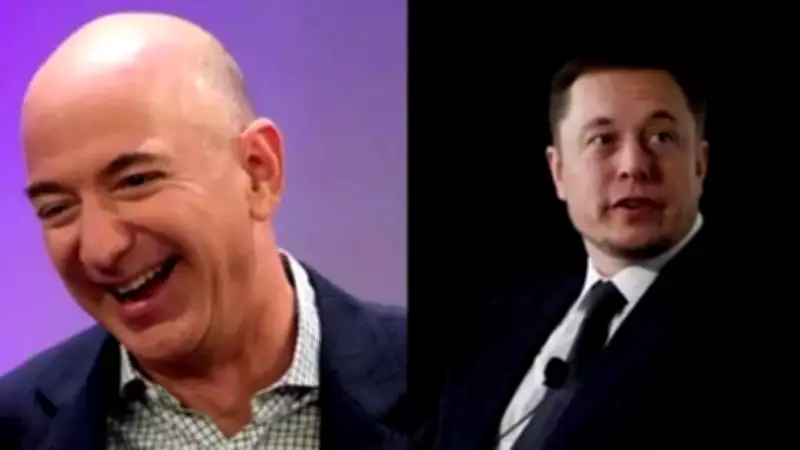
The achievement caught the attention of SpaceX CEO Elon Musk, who publicly congratulated Jeff Bezos on the successful launch. "Congrats," Musk wrote in response to Bezos' post. This exchange marks a notable moment of public recognition between the two space industry rivals.
Earlier in April, Musk had also complimented a nighttime photograph of the New Glenn rocket on its launch pad, describing it as "Looks dood" in another social media interaction. These public acknowledgments occur against a backdrop of intense competition and regulatory disputes between their respective companies.
Ongoing Regulatory Battles at the FCC
The friendly exchanges between the billionaires contrast sharply with the ongoing conflicts between their companies at the Federal Communications Commission. Both Amazon and SpaceX have filed multiple complaint letters against each other's satellite proposals with the US communications regulator.
Recently, SpaceX submitted a formal letter to the FCC regarding Amazon's petition to deny SpaceX's application for operating one million satellites designed as orbiting data centers. In its filing, SpaceX argued that if regulators apply Amazon's criticisms to its proposal, they must equally apply those standards to Blue Origin's competing application.
Blue Origin's Ambitious Satellite Constellation Proposal
Jeff Bezos' rocket company has filed its own application with the FCC to launch up to 51,600 artificial intelligence satellites into orbit. Blue Origin's filing presents these orbiting servers as "a complement to terrestrial infrastructure" that would operate independently of Earth-based constraints.
The company argues that explosive growth in artificial intelligence workloads, machine learning applications, and cloud computing is creating unprecedented demand for data center capacity. According to their submission, terrestrial infrastructure alone faces severe limitations in scaling to meet this demand, making orbital data centers a necessary technological evolution.
SpaceX appears to be strategically turning Amazon's regulatory arguments back against Blue Origin, advocating for consistent regulatory treatment across all competing space-based infrastructure projects. This creates a complex dynamic where the companies are simultaneously collaborating on advancing space technology while competing fiercely for regulatory approval and market position.
The successful New Glenn launch demonstrates tangible progress in reusable rocket capabilities, while the ongoing FCC disputes highlight the strategic battles shaping the future of orbital infrastructure. As both companies advance their technologies, their interactions—both collaborative and competitive—will continue to influence the development of space-based services and infrastructure.