

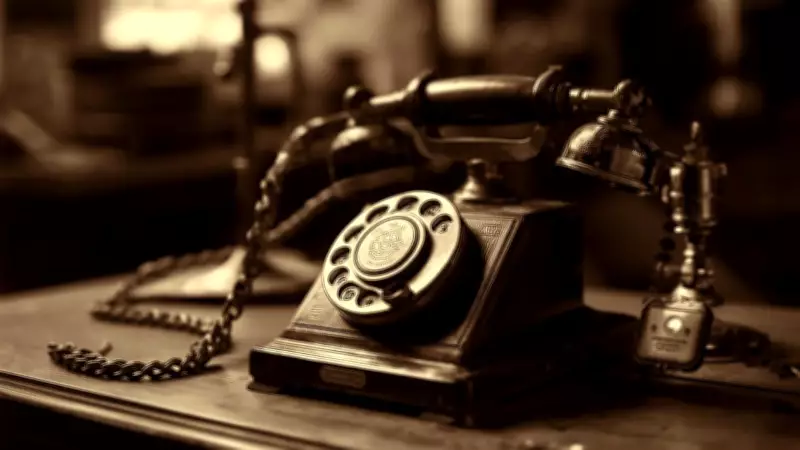
The First Telephone Call: Alexander Graham Bell's Historic Breakthrough
Imagine a world devoid of instant communication across continents—no video calls with loved ones, no urgent work conversations, and no whispered sweet nothings from afar. On March 10, 1876, in a cluttered Boston laboratory, Alexander Graham Bell shattered that silence with nine simple words directed at his assistant, Thomas Watson: "Mr Watson, come here, I want to see you." Crackly yet clear, those words traveled through a wire, marking the birth of the telephone era and igniting a communication revolution that would forever shrink distances and transform society.
Alexander Graham Bell's Eureka Moment: From Accident to Invention
Alexander Graham Bell, a Scottish-born teacher of the deaf, initially focused on developing a "harmonic telegraph" to transmit multiple messages over a single wire using different sound pitches. However, serendipity played a crucial role in his breakthrough. As documented in his lab notebook at the Library of Congress, Bell spilled battery acid on his leg one fateful evening. In a moment of urgency, he summoned Watson from the adjacent room using his liquid-transmitter device. Watson distinctly heard the words: "Mr Watson, come here, I want to see you." Rushing over, Watson confirmed the successful voice transmission, proving it was not a mere fluke.
This achievement was rooted in Bell's deep expertise in sound waves, honed through teaching visible speech to deaf students, including his wife Mabel. Inspired by his father Alexander Melville Bell's system for visualizing speech, Bell pursued acoustic experiments. By 1875, he revealed in a letter to his father his reliance on "electrical undulations identical in nature with the air waves." This persistence culminated in the first telephone call, a bi-directional marvel where Watson could reply, demonstrating it was not a one-way trick.

The Race Against Elisha Grey and Patent Controversies
Bell faced intense competition, notably from inventor Elisha Grey. On February 14, 1876, both filed patent caveats within hours of each other—Bell's at 11:30 am via his lawyer Gardiner Greene Hubbard, and Grey's shortly after. Controversy lingers over whether Bell borrowed ideas from Grey's caveat, but a US Supreme Court ruling in 1888 upheld Bell's patent. Bell's advantage lay in his understanding of transmitting the full waveform of voice, not just tones. In his 1876 deposition, Bell explained: "The sounds are produced by the vibrations of sonorous bodies... and these vibrations are converted into corresponding electrical undulations."
Undeterred by rivalry, Bell publicly demonstrated his invention at the Philadelphia Centennial Exhibition in June 1876. Brazilian Emperor Dom Pedro II marveled at the technology, exclaiming, "It is marvellous!" Orders quickly flooded in, and by 1877, Bell's invention began to spread. On January 25, 1915, during the first transcontinental call, Bell repeated his iconic words to Watson, now 3,400 kilometers away in San Francisco. Watson humorously replied, "It would take me a week to get to you now." From a laboratory whisper to a global network, the telephone exploded in popularity: by 1880, there were 60,000 phones in the US, and millions by the century's end.
The Telephone's Profound Impact on Society and Human Connection
Those nine words ignited unstoppable change, democratizing communication and toppling isolation. Rural farmers could call markets, doctors consulted experts during surgeries, and lovers bridged oceans. As Bell envisioned in a 1876 letter to his father, "We are on the eve of a new era... civilized people will be able to talk to each other regardless of distance." Businesses flourished with innovations like stock tickers and news wires, accelerating commerce. Wars transformed as generals coordinated via field phones, potentially saving lives.

However, the telephone also brought challenges, such as eroded privacy and eavesdropping on tapped lines. Simultaneously, it empowered women, challenging Victorian norms as female "hello girls" manned switchboards. Globally, it spurred imperial connections, like Britain's Imperial cable linking colonies. Today, smartphones trace their roots to Bell's wire, evolving into advanced 5G networks. UNESCO honors this invention as pivotal, with Bell's notebook enshrined as a UNESCO Memory of the World treasure, preserving the hastily scripted, ink-blotted words: "Mr Watson, come here I want you."
Bell's Legacy and Lasting Influence
After achieving fame, Bell remained humble, pursuing interests in aeronautics, hydrofoils, and deaf education, founding schools to support the latter. Upon his death in 1922, US telephone networks observed a minute of silence, with 6,000 kilometers of wire falling still. Watson recalled in his 1935 memoir: "I was alone in the lab... those words thrilled me." That thrill continues to echo in every ringtone, proving that nine simple words can rewire destiny.
From the dim glow of a Boston lab to modern satellite beams, the first telephone call reminds us that genius sparks from curiosity, rivalry hones it, and simple words propel humanity forward.





