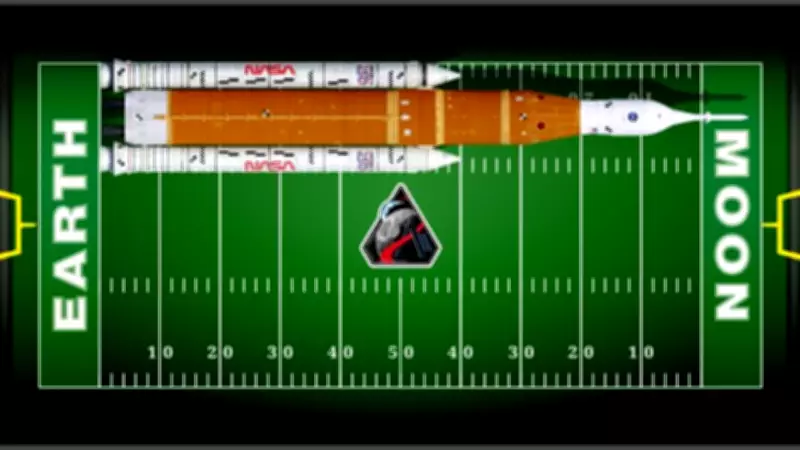
NASA's Artemis II Moon Rocket: A Football Field-Sized Giant
The Artemis II moon rocket, developed by NASA, is an engineering marvel of immense proportions. If laid horizontally, this colossal spacecraft would stretch nearly the entire length of a standard American football field. The Space Launch System (SLS) rocket stands at an impressive 322 feet tall, which is just a few yards shorter than the 360-foot length of a football gridiron. This makes it one of the tallest and most powerful rockets ever constructed by humanity.
Comparing the Artemis II to Earthly Landmarks
To grasp the sheer scale of the Artemis II rocket, consider this: it is larger than many famous landmarks on Earth. When placed end-to-end with the International Space Station, which measures approximately 357 feet including its expansive solar arrays, the combined length would nearly match that of a football field including both end zones. This visual comparison highlights the monumental size of NASA's latest lunar exploration vehicle.
Mission Objectives and Crew Details
Designed to transport astronauts beyond low-Earth orbit, the Artemis II rocket is tasked with sending a crew of four on an ambitious 10-day journey around the moon and back to Earth. The mission will feature three NASA astronauts and one astronaut from the Canadian Space Agency, marking a significant international collaboration. A primary goal of this flight is to rigorously test the Orion spacecraft's life support systems in preparation for future lunar landing missions.

The Slow Rollout to Launch Pad 39B
Earlier this year, the massive Artemis II rocket was meticulously moved from NASA's iconic Vehicle Assembly Building to Launch Pad 39B at the Kennedy Space Center in Florida. This painstaking journey took nearly 12 hours to complete. Transported at a cautious speed of about 1 mile per hour atop a massive crawler transporter, the towering SLS rocket dominated the skyline of the historic launch complex, evoking memories of the Apollo era.
Launch Delays and Technical Challenges
NASA had initially targeted a launch window as early as February for the Artemis II mission, which would represent the first human voyage beyond low-Earth orbit since the Apollo missions concluded over five decades ago. However, the agency has since announced that the launch will not be attempted until at least March due to technical setbacks.
The delay followed an unsuccessful countdown rehearsal at the launch pad. Although this test did not involve astronauts and the rocket's engines were not scheduled to ignite, critical issues emerged during the fueling process. Hydrogen leaks were detected—a problem that also plagued the uncrewed Artemis I mission before it successfully orbited the moon in 2022.
Despite concerted efforts to proceed with the rehearsal, including fully fueling the rocket and entering the final minutes of the countdown, the persistent hydrogen leak recurred. The test was ultimately scrubbed shortly after midnight, with approximately five minutes remaining on the clock.
The Path Forward for Lunar Exploration
NASA has emphasized that Artemis II is a crucial stepping stone in the ambitious plan to return humans to lunar orbit. This mission is designed to pave the way for subsequent Artemis missions, which aim to land astronauts on the moon's surface, establish a sustainable presence, and eventually support crewed missions to Mars. The successful execution of Artemis II will validate key technologies and operational procedures essential for deep space exploration.