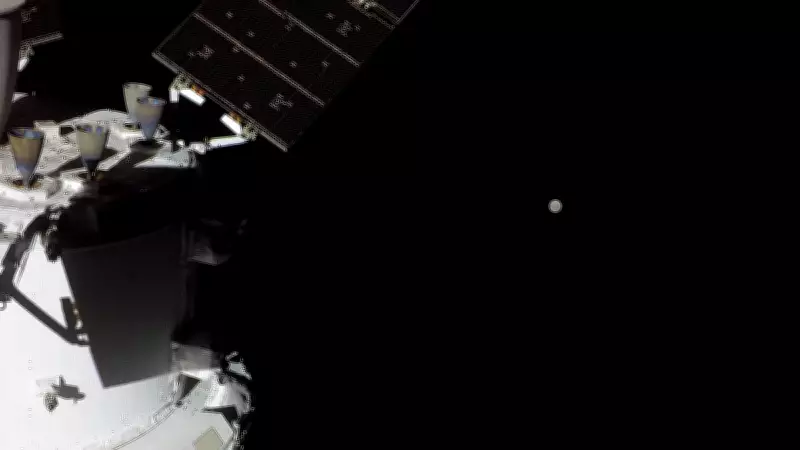
NASA's Artemis II Mission Achieves Crucial Milestone in Lunar Journey
In a significant development for space exploration, NASA has announced that its Artemis II mission is now closer to the Moon than Earth. This milestone marks a pivotal moment in the mission's trajectory as it progresses toward its goal of a crewed lunar flyby. The spacecraft, carrying a team of astronauts, is on a path that will take it into a distant retrograde orbit around the Moon, setting the stage for future human landings.
Details of the Mission's Current Position and Progress
The Artemis II mission, launched as part of NASA's broader Artemis program aimed at returning humans to the lunar surface, has been traveling through space since its departure. Recent tracking data confirms that the spacecraft has crossed the point where the gravitational pull of the Moon exceeds that of Earth, placing it in a region where lunar influence dominates. This transition is critical for the mission's navigation and timing, as it allows for precise maneuvers to enter lunar orbit.
Key aspects of the mission's progress include:

- The spacecraft is now approximately 240,000 miles from Earth, while the Moon is about 238,900 miles away at its average distance, making the mission technically closer to the lunar surface.
- This positioning enables NASA to test systems and procedures in deep space, including life support, communication, and propulsion, under conditions similar to those expected for future Artemis missions.
- The crew on board, which includes astronauts from NASA and international partners, is conducting experiments and monitoring the spacecraft's performance as it approaches the Moon.
Implications for Future Space Exploration and NASA's Goals
The achievement of being closer to the Moon than Earth is not just a symbolic milestone; it has practical implications for the success of the Artemis program. By reaching this point, NASA demonstrates the viability of its spacecraft and mission planning, paving the way for Artemis III, which aims to land astronauts on the lunar surface by the mid-2020s. This mission serves as a crucial test bed for technologies that will support sustained human presence on the Moon and eventual missions to Mars.
Experts highlight that this phase of the mission allows for real-time data collection on radiation exposure, microgravity effects, and navigation in deep space, all of which are essential for long-duration space travel. The Artemis II mission is expected to complete its lunar flyby and return to Earth in the coming weeks, providing valuable insights for future endeavors.
In summary, NASA's Artemis II mission has reached a historic juncture by moving closer to the Moon than Earth, underscoring the agency's commitment to advancing human space exploration. As the mission continues, it sets the stage for a new era of lunar and interplanetary travel, with implications for science, technology, and international collaboration in space.